
Body Meridians
Quick answer
Body meridians are traditional pathways used in acupuncture to describe how energy moves through the body. This framework includes 12 principal meridians, most linked to a major organ and a hand or foot, and 8 extraordinary meridians described as energy reservoirs. This guide explains the system’s paths, Yin and Yang flow, Five Elements associations, and voltage-testing context.
[object Object],, Nutritionist and Integrative Nutrition Health Coach
What Does the Meridian System Look Like?
The 12 Principal Meridians
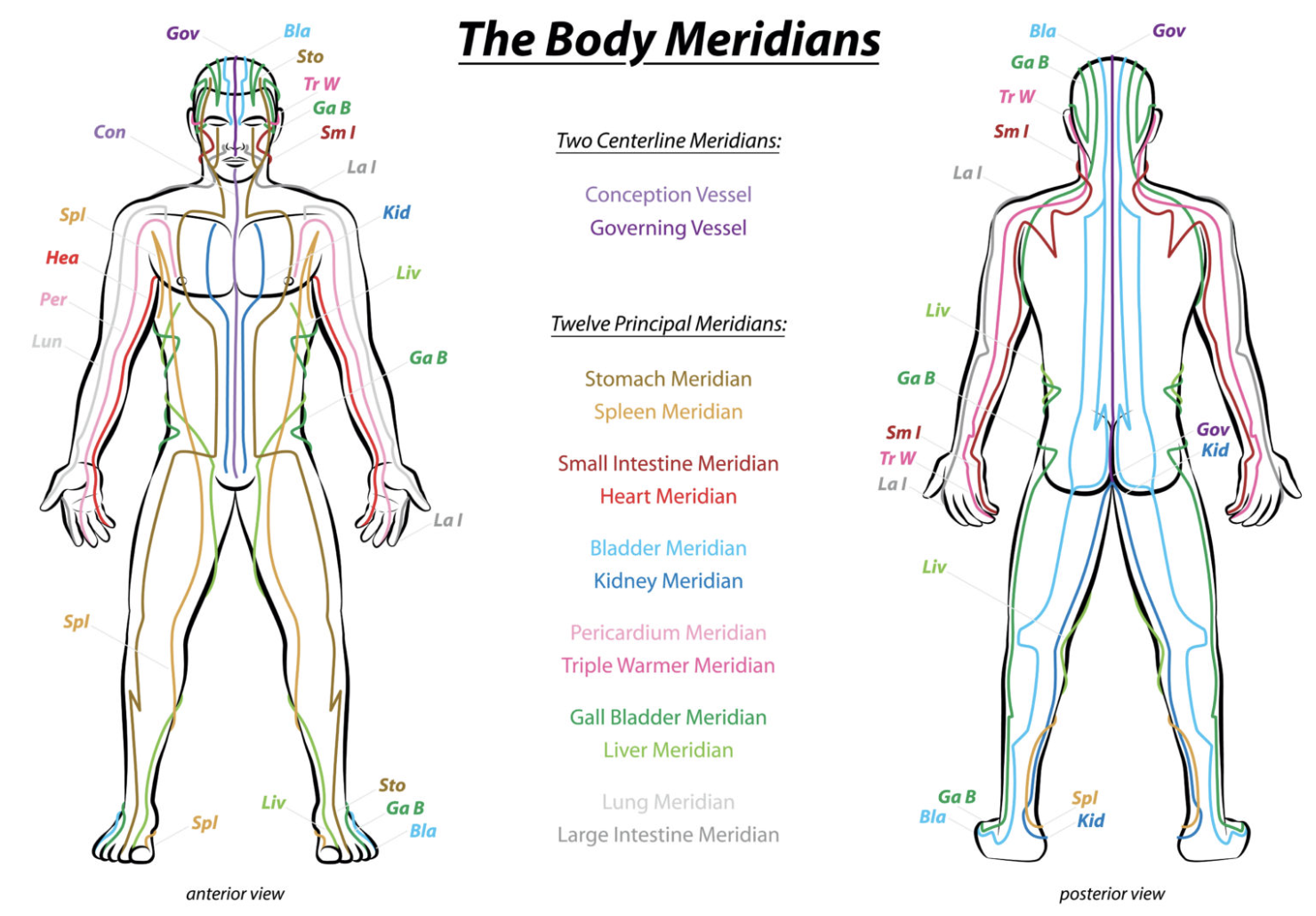
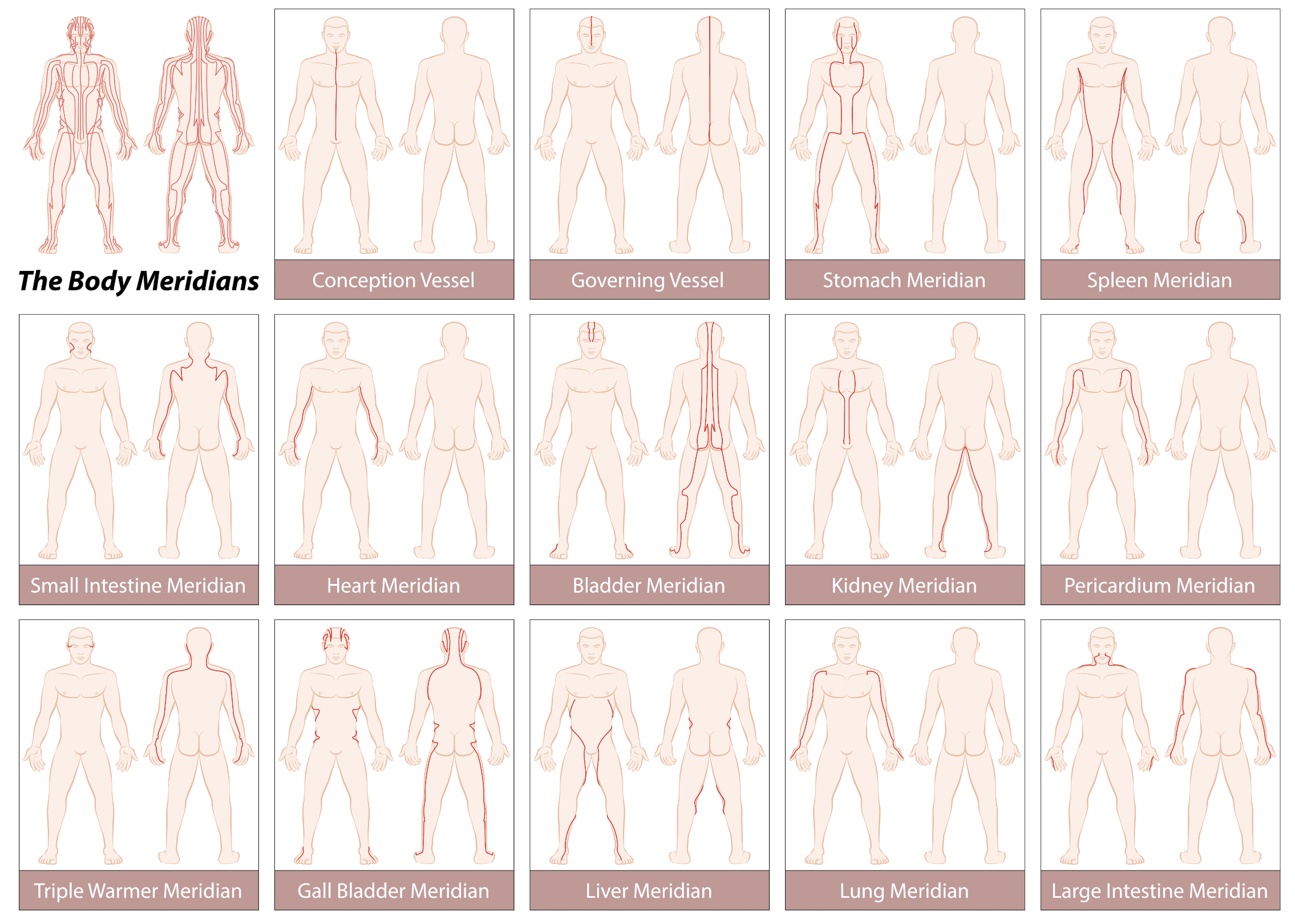
The Principal Meridians are the twelve “standard” meridians. Most of these meridians correspond with a specific major organ. All the Principal Meridians run through a peripheral limb—either a hand or a foot. From there, each channel travels either up or down the body.
Principle Meridians are separated into organs with “hollow” and “solid” categories.
The hollow organs, also known as YANG, are the stomach, bladder, gallbladder, large intestine, and small intestine. The flow of YANG meridians is DOWN the body.
The solid organs, also known as YIN, are the heart, liver, spleen, kidneys, and lungs. The flow of YIN meridians is UP the body.
Stomach · Bladder · Gallbladder · Large Intestine · Small Intestine · Triple Warmer
The 8 Extraordinary Meridians
There eight Meridians known as Extraordinary Meridians. Keep in mind that the concept of the brain did not exist when this system of meridians was first conceived! Extraordinary Meridians act as reservoirs of energy in relation to the Principle Meridians which are compared to rivers.
“...when the Qi of the channels overflows, it flows into the extraordinary vessels where it is turned into irrigation, warming the organs internally and irrigating the space between skin and muscles externally.”
— The Study of the Eight Extraordinary Vessels by Li Shi Zhen
Because all the Extraordinary Vessels derive directly or indirectly from the Kidneys, they play an important role in the defense against exterior pathogenic factors.
Extraordinary Meridians are the Conception Vessel and Governing Vessel, Penetrating, Girdle, Yang Heel, Yin Heel, Yang Linking, and Yin Linking.
Two complicated meridians are known as the Conception Vessel and Governing Vessel. These two meridians most closely align with the Sympathetic and Parasympathetic Nervous Systems and the control of the brain over the rest of our body. They are sometimes added to the Principle Meridians and also categorized as Extraordinary Meridians. This is because they have points on the body like Principle, but act as reservoirs like the Extraordinary.
Meridians and the Five Elements
The Meridian System follows the Five Elements theory, in which different qualities, both physical and symbolic, are grouped within five categories. Each element has a range of qualities that are used to diagnose disease and dysfunction. They also provide prognostic tools to help the body regain balance and health. While there is no scientific basis in the Five Elements theory, it is important to understand the theory for the practice of acupuncture.
This concept of meridians is a different model than the reductive, Western biological model and is holistic in nature. Dysfunction and disease are not a result of pathology. Instead, imbalances in voltage and other energetic systems lead to health problems. The causes of imbalance, where there may be too much or too little energy, are often thought to derive from, or to have been influenced by, the patient’s own actions. Health issues are not often thought to be caused by an external source.
How do your teeth fit into these meridians? Read Are Root Canals Doomed to Fail?.
For more on this material, see The Twelve Meridians of Acupuncture.
What Do Teeth and Root Canals Have to Do With Meridians?
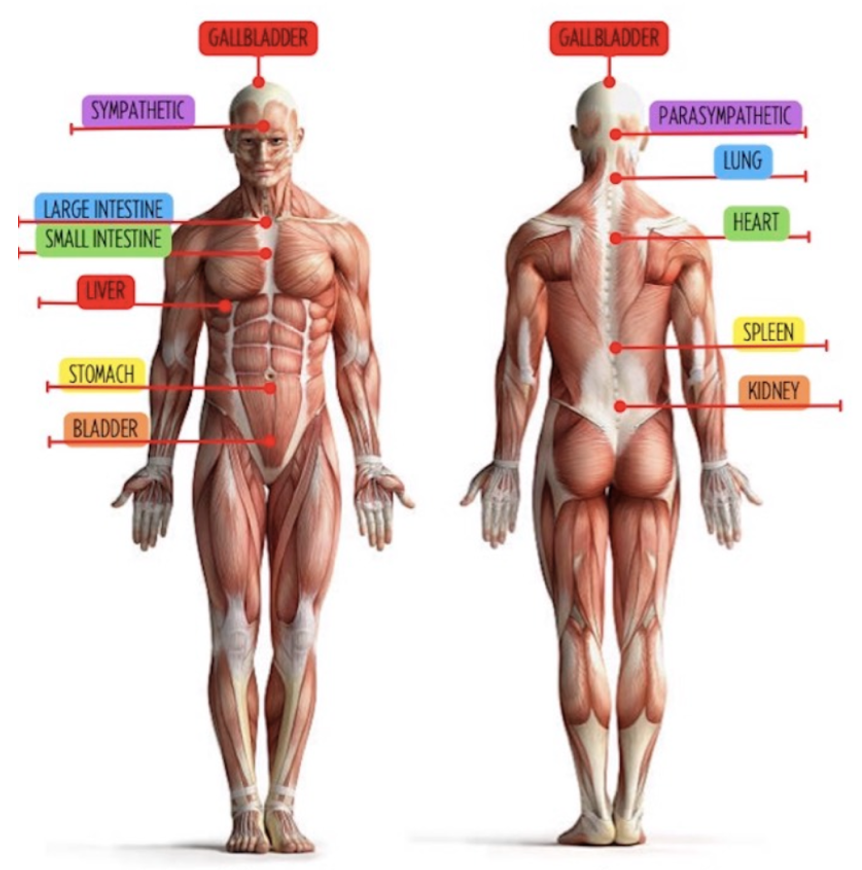
In Dr. Jerry Tennant’s Healing Is Voltage framework, teeth are associated with specific acupuncture meridians. Tennant proposes that an infected tooth or root canal may interfere with voltage along the corresponding meridian and may sometimes be worth investigating when unexplained pain or dysfunction repeatedly occurs elsewhere along that circuit. This is one reason I look at dental history when considering chronic or unexplained symptoms.
Checking Meridian Voltage
Touch, point to, or think about these meridian points or the name of the meridians while doing muscle testing to check for voltage.
A “yes” or clockwise rotation is a (-) healthy voltage.
A “no' or counter-clockwise rotation is an (+) unhealthy voltage.
How Did Meridian and Acupuncture Practices Develop?
Acupuncture and the Meridian System have a long history that dates back over 2,500 years ago. While it is unclear whether acupuncture originated in China, its practice is well-documented. The oldest ancient text that references acupuncture dates back to 100 BC, and other texts dating back to 600-500 BC reference acupuncture points without procedures. Archaeologists found gold and silver needle artifacts for acupuncture in ancient tombs. The needles and the texts mentioned are the first documentation of the already-established practice.
By the 4th century AD, most modern acupuncture points had been identified with documentation. The highest levels of medieval Chinese society used acupuncture. The emperors of many dynasties even kept acupuncturists on retainer. Medieval Chinese medical colleges even taught courses in acupuncture and the Meridian System. During the Ming Dynasty, “The Great Compendium of Acupuncture and Moxibustion” established most of the acupuncture practices that are still used today.
However, around the 13th century, acupuncture began to decline in status. It became associated with mysticism and was seen as a less legitimate practice. Following modern scientific medicine, acupuncture became known as a lost art in China. Right around this time, acupuncture started to be used in Europe. Still, Western medicine viewed acupuncture with some suspicion. The focus on energetic and symbolic systems felt too superstitious. By the mid-19th century, Western interest in acupuncture waned.
It was not until the mid-20th century that acupuncture would make a comeback. Mao Zedong endorsed acupuncture to unite communist China behind a shared cultural history. By the 1950s, Chinese hospitals used acupuncture. Modern research also began to examine acupuncture from a rational, scientific standpoint. In 1997, the National Institutes of Health recommended acupuncture as a complementary treatment. Since then, acupuncture has become the most popular alternative medicine in the US.
The Centerline Extraordinary Meridians
The Conception and Governing Vessels are the two central pathways described below. In this framework, both begin at the base of the pelvis and travel along the front or back of the body.
The Conception Vessel
Sympathetic Nervous System
Traditional description of the Conception Vessel
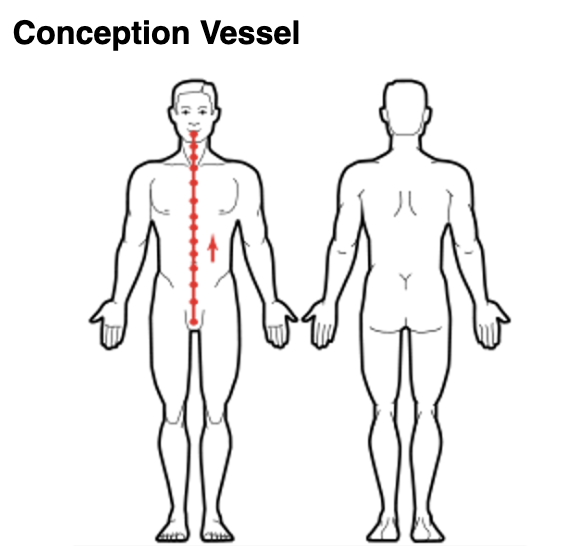
Much like the governing vessel, the conception vessel is not one of the 12 principal meridians. Also, like the governing vessel, the conception vessel is often manipulated in acupuncture. It is also known as the “Sea of Yin Meridians.” It receives the voltage from the yin meridians before distributing it to the yang meridians. The conception vessel is responsible for circulating voltage throughout the body. It also controls the reproductive cycle and libido.
The conception vessel helps control the 7-year life cycle. It also generates the Guardian voltage that the governing vessel controls. It is one of the two most important meridians.
The conception vessel begins at the base of the pelvis and travels up the front of the body to the lower lip.
The conception vessel has 24 acupoints.
The Governing Vessel
Parasympathetic Nervous System
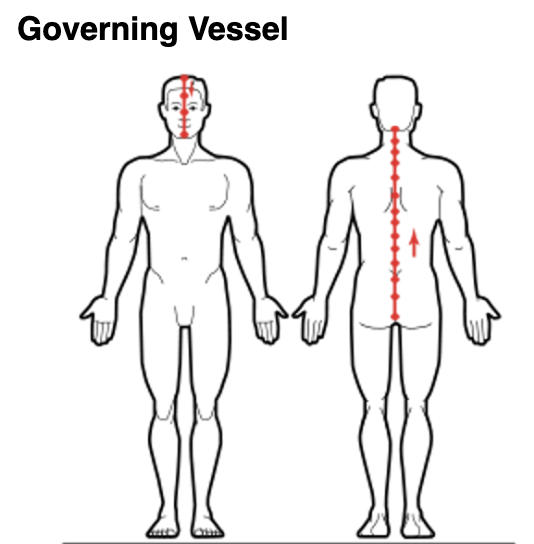
Traditional description of the Governing Vessel
Though not one of the 12 Principal Meridians, the governing vessel is often reflexed in acupuncture. Called “The Sea of Yang Meridians,” the governing vessel controls the Yang Meridians. It also controls the Guardian voltage, and both are associated with the immune system and the ability to fight off external disease. It is also said to be the “fire” of the body and responsible for body heat.
The governing vessel also works with the kidneys to regulate the brain. Along with the conception vessel, it is one of the two most important meridians.
The governing vessel begins at the base of the pelvis and travels up the back, over the top of the head to right above the upper lip.
The governing vessel has 28 acupoints.
Principal Meridian Reference
The following reference guide summarizes the traditional associations, directional flow, pathways, and characteristics of each of the twelve principal meridians.
The Lung Meridian
| Attribute | Traditional association |
|---|---|
| Element | Metal |
| Direction | West |
| Sense Organ | Nose |
| Sense | Smell |
| Tissue | Skin and Hair |
| Positive Emotion | Courage |
| Negative Emotion | Grief |
| Flavor | Pungent (Umami) |
| Color | White |
| Sound | Crying |
| Smell | Rotten |
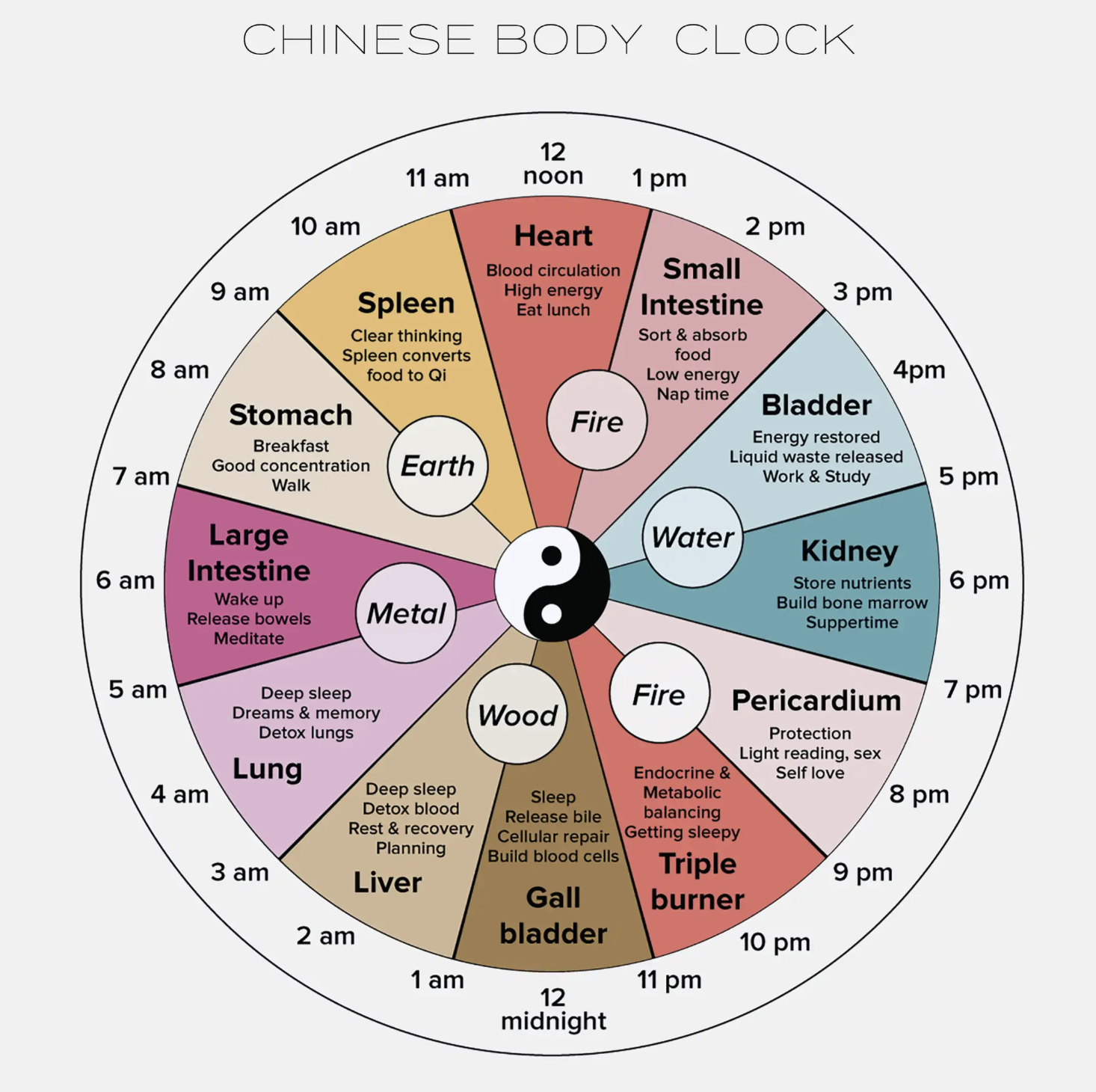
| Time | 3 a.m. – 5 a.m. |
| Opposite | Bladder |
| Yin/Yang | Yin |
| Flow Direction | Up |
| Origin/Ending | Chest to Hand |
| Number of Acupoints | 11 |
Traditional description and pathway
The lung meridian is second only to the heart meridian among the 12 Principal Meridians. It is called the “Prime Minister” and assists with controlling energy and circulating the blood. The lungs and the heart are seen to work in conjunction with blood and energy, being complementary parts of the living system. The lungs also control the skin and perspiration.
The lung meridian generates what is known as the radiant energy. This control puts the lungs in the front line for fighting external disease. The lungs also connect the mind to the body through breathing. Imbalances in the lung meridian can cause upper respiratory infection, breathing dysfunction, and skin problems. An imbalance can also cause despair and anxiety.
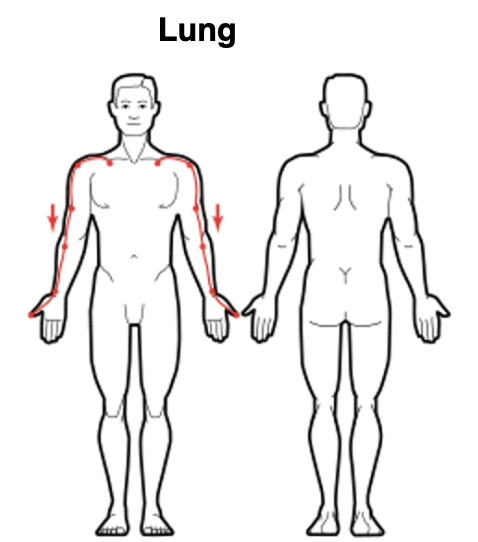
The lung meridian begins at the front of the shoulder. It notches up before running down the top of the inner arm and ending at the corner of the thumbnail.
The Large Intestine Meridian
| Attribute | Traditional association |
|---|---|
| Element | Metal |
| Sense Organ | Nose |
| Sense | Smell |
| Tissue | Skin and Hair |
| Positive Emotion | Courage |
| Negative Emotion | Grief |
| Flavor | Pungent (Umami) |
| Color | Off-White |
| Sound | Crying |
| Smell | Rotten |
| Time | 5 a.m. – 7 a.m. |
| Opposite | Kidney |
| Yin/Yang | Yang |
| Flow Direction | Down |
| Origin/Ending | Hand to Face |
| Number of Acupoints | 20 |
Traditional description and pathway
The large intestine is in charge of making solid waste from liquid. Known as the “Master of Transportation,” it is the final organ before solid waste is eliminated. The large intestine works closer with its paired organ than most. The lungs move the large intestine by breathing. The large intestine balances the body’s fluids and works with the lungs in perspiration.
An imbalance in the large intestine meridian can cause constipation, diarrhea, and abdominal pain. Depression and excessive worry can also be caused by an imbalance of this meridian.
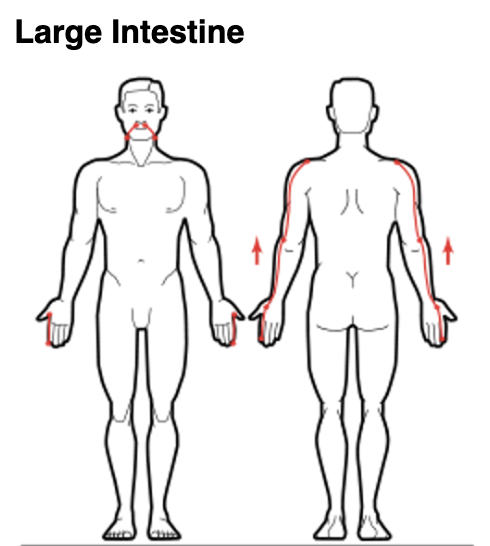
The large intestine meridian starts at the outside of the index fingernail. It travels up the top of the arm before crossing to the back of the shoulder. It crosses back over the shoulder, runs up the throat, and ends just below the nose.
The Heart Meridian
| Attribute | Traditional association |
|---|---|
| Element | Fire |
| Sense Organ | Tongue |
| Sense | Touch |
| Tissue | Vessels |
| Positive Emotion | Joy |
| Negative Emotion | Arrogance |
| Flavor | Bitter |
| Color | Red |
| Sound | Laughter |
| Smell | Scorched |
| Time | 11 a.m. – 1 p.m. |
| Opposite | Gall Bladder |
| Yin/Yang | Yin |
| Flow Direction | Up |
| Origin/Ending | Chest to Hand |
| Number of Acupoints | 9 |
Traditional description and pathway
The Heart is known as the King of the Organs. It commands all of the other organs and emotions. The heart is also seen as the seat of the mind. It works with many organs to regulate circulation and maintain a healthy mental state. If the heart is imbalanced, all the other organs and meridians will suffer. It is also seen as primary in the defense against disease.
The tongue is used in diagnosing heart imbalances. Speech impediments or being mute are considered to have been caused by an imbalance in the heart meridian. As a source of bodily heat and circulation of the blood, a pallid facial complexion can also diagnose heart meridian imbalances. All manner of mental and emotional issues can also occur from an imbalance of the heart meridian.
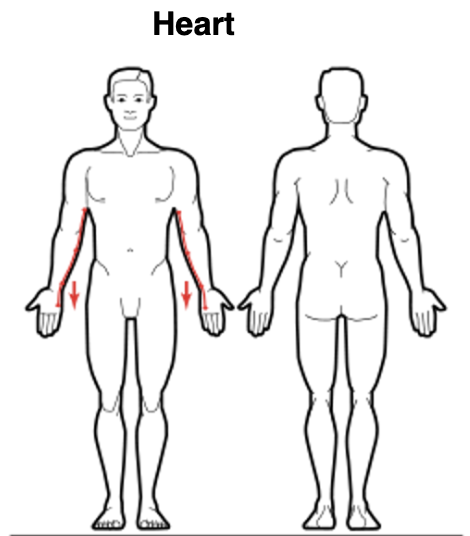
The heart meridian begins near the armpit and runs down the lower inner arm before ending at the tip of the little finger.
The Small Intestine Meridian
| Attribute | Traditional association |
|---|---|
| Element | Fire |
| Sense Organ | Tongue |
| Sense | Touch |
| Tissue | Vessels |
| Positive Emotion | Joy |
| Negative Emotion | Arrogance |
| Flavor | Bitter |
| Color | Pink Red |
| Sound | Laughter |
| Smell | Scorched |
| Time | 1 p.m. – 3 p.m. |
| Opposite | Liver |
| Yin/Yang | Yang |
| Flow Direction | Down |
| Origin/Ending | Hand to Face |
| Number of Acupoints | 19 |
Traditional description and pathway
Responsible for receiving food during the digestion process, the small intestine is known as the “Minister of Reception.” It separates impurities from the food before passing the waste on and also absorbs water.
It should come as no surprise that the small intestine meridian is responsible for digestion. But, this meridian also works with the heart meridian.
It controls the basic emotions, and the Chinese equivalent of “a broken heart” is “broken intestines.” The meridian also works with the pituitary gland, also known as the “master gland,” to regulate growth and the endocrine system.
Imbalance in the small intestine meridian can cause emaciation and pain in the abdomen. It can also lead to poor reasoning ability and restlessness.
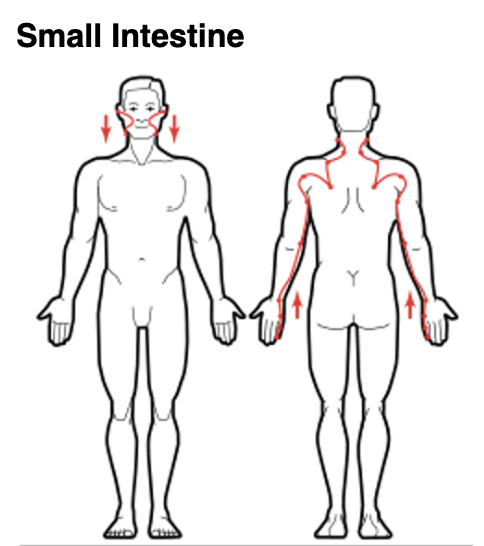
Starting at the tip of the little finger, the small intestine meridian runs up the lower back of the arm. It zig-zags at the back of the shoulder before ascending up the side of the neck. At the cheek, it moves outward, ending at the front of the ear.
The Spleen Meridian
| Attribute | Traditional association |
|---|---|
| Element | Earth |
| Sense Organ | Mouth |
| Sense | Taste |
| Tissue | Muscles |
| Positive Emotion | Compassion |
| Negative Emotion | Anxiety |
| Flavor | Sweet |
| Color | Yellow |
| Sound | Singing |
| Smell | Fragrant |
| Time | 9 a.m. – 11 a.m. |
| Opposite | Triple Warmer |
| Yin/Yang | Yin |
| Flow Direction | Up |
| Origin/Ending | Foot to Chest |
| Number of Acupoints | 21 |
Traditional description and pathway
This meridian includes the pancreas and is, in part, responsible for digestion. The spleen meridian is referred to as the “Minister of the Granary.” Nutrients from food and beverages are extracted by enzymes produced in the spleen and pancreas. The meridian regulates the quantity and the quality of blood in circulation.
The spleen meridian works with the lung meridian to generate True Human Energy. This meridian is affected by the tone of muscles, which affects them in turn. The spleen meridian is responsible for logical and analytical thinking. It is also the first meridian in memory formation.
Imbalances in the spleen meridian can be diagnosed from the mouth. Red, moist lips indicate an excess of splenetic energy, while pale, dry lips indicate the opposite. A bad temper and moodiness are associated with splenetic imbalances.
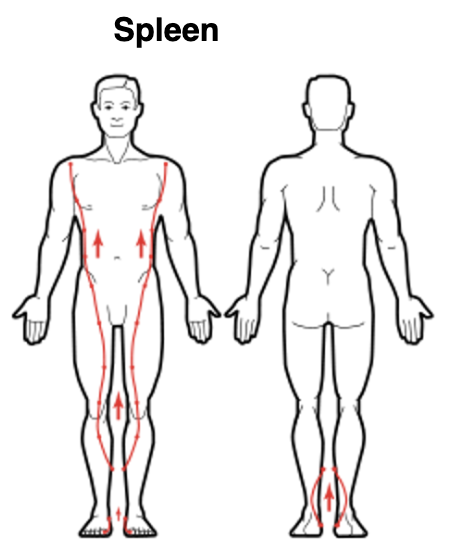
The spleen meridian begins at the tip of the big toe and travels up the inside of the leg. It moves in and out of the stomach until it travels up the side of the body and ends underneath the front of the shoulder.
The Stomach Meridian
| Attribute | Traditional association |
|---|---|
| Element | Earth |
| Sense Organ | Mouth |
| Sense | Taste |
| Tissue | Muscles |
| Positive Emotion | Compassion |
| Negative Emotion | Anxiety |
| Flavor | Sweet |
| Color | Yellow |
| Sound | Singing |
| Smell | Fragrant |
| Time | 7 a.m. – 9 a.m. |
| Opposite | Pericardium |
| Yin/Yang | Yang |
| Flow Direction | Down |
| Origin/Ending | Face to Foot |
| Number of Acupoints | 45 |
Traditional description and pathway
The stomach is in charge of elemental balance. Called the “Sea of Nourishment” and the “Minister of the Mill,” it is the start of digestion. Because of the umbilical cord, it is also called the “Root of Postnatal Life.” The stomach is tasked with extracting the energy from food and beverages.
Working with the spleen, the stomach transports the energy throughout the Meridian System. The stomach also uses the different types of food eaten to balance the five elemental energies.
An imbalance with the stomach meridian will cause energetic deficiencies across the Meridian System. It can also cause mania, confusion, or anxiety.
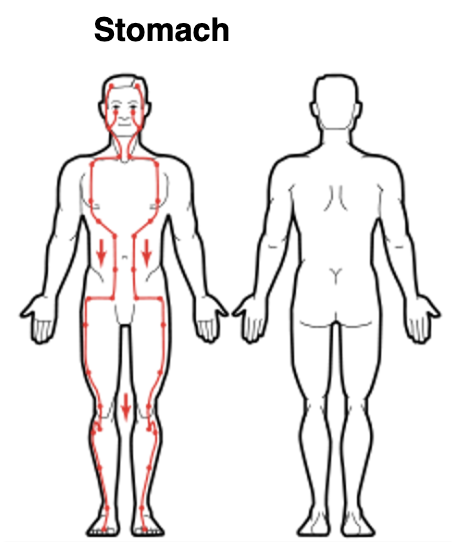
The stomach meridian begins under the eye, next to the nose. It descends before following the jawline up to the skull. It then drops and flows down the throat, chest, and abdomen. Continuing, it runs down the front of the legs and feet before ending at the big toe’s outside edge.
The Kidney Meridian
| Attribute | Traditional association |
|---|---|
| Element | Water |
| Sense Organ | Ears |
| Sense | Hearing |
| Tissue | Bones |
| Positive Emotion | Gentleness |
| Negative Emotion | Fear |
| Flavor | Salty |
| Color | Black |
| Sound | Groaning |
| Smell | Putrid |
| Time | 7 p.m. – 9 p.m. |
| Opposite | Large Intestine |
| Yin/Yang | Yin |
| Flow Direction | Up |
| Origin/Ending | Foot to Chest |
| Number of Acupoints | 27 |
Traditional description and pathway
The kidney is seen as one of the most important organs. This organ includes the adrenal glands and the sex glands of men and women. It is known as the “Minister of Power” as well as the “Root of Life.” It is tasked with storing the prenatal energy as well as the essential vital energy for life. The kidney also works at regulating the brain and plays an important role in the formation of memories and rationality.
An imbalance in the kidneys can cause impotency or an immune deficiency. It can also lead to a poor memory or an inability to think clearly. Diagnosis of kidney meridian imbalances is done by examining the eyes and hearing. Back pain and a short attention span also indicated a kidney meridian imbalance.
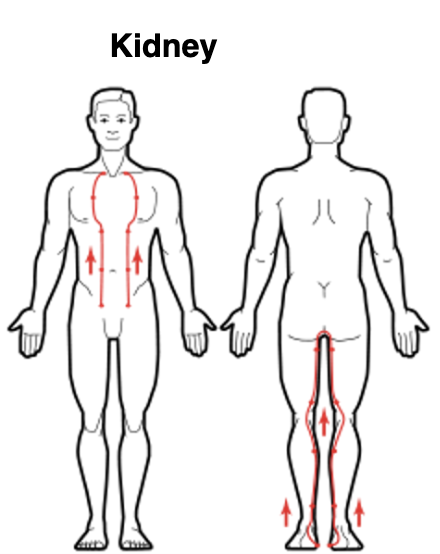
The kidney meridian starts at the sole of the foot and runs along the inner edge before looping around the ankle. It ascends the inner leg and runs up the central torso before ending at the inner collarbone.
The Bladder Meridian
| Attribute | Traditional association |
|---|---|
| Element | Water |
| Sense Organ | Ears |
| Sense | Hearing |
| Tissue | Bones |
| Positive Emotion | Gentleness |
| Negative Emotion | Fear |
| Flavor | Salty |
| Color | Deep Black |
| Sound | Groaning |
| Smell | Putrid |
| Time | 3 p.m. – 5 p.m. |
| Opposite | Lung |
| Yin/Yang | Yang |
| Flow Direction | Down |
| Origin/Ending | Face to Foot |
| Number of Acupoints | 67 |
Traditional description and pathway
The bladder is referred to as the “Minister of the Reservoir.” While the organ only stores and eliminates liquid waste, the energetic function involves balancing the autonomous nervous system. This is in part because the bladder meridian spans the height of the body and runs alongside the spinal column. The bladder plays a role in regulating the sympathetic and parasympathetic responses.
An imbalance of the bladder meridian can cause lower back pain or lower back weakness, as well as urinary problems. A bladder meridian imbalance can also cause one to be fearful or stubborn.
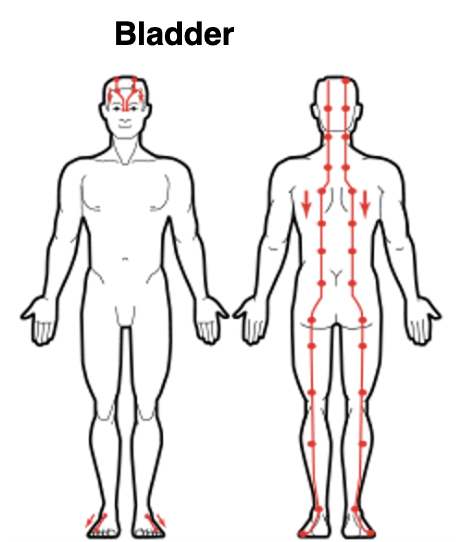
The bladder meridian begins at the inner eye and runs up the skull, where it works outwards before running down the back. The meridian then follows the hip and sacral nerves before running down the back of the leg and ends outside of the baby toe.
The Liver Meridian
| Attribute | Traditional association |
|---|---|
| Element | Wood |
| Sense Organ | Eyes |
| Sense | Sight |
| Tissue | Tendons |
| Positive Emotion | Kindness |
| Negative Emotion | Anger |
| Flavor | Sour |
| Color | Deep Green |
| Sound | Shouting |
| Smell | Scorched |
| Time | 1 a.m. – 3 a.m. |
| Opposite | Small Intestine |
| Yin/Yang | Yin |
| Flow Direction | Up |
| Origin/Ending | Foot to Chest |
| Number of Acupoints | 14 |
Traditional description and pathway
The liver is considered one of the primary organs. It is called the “Chief of Staff” of the “General”. This is in part because the liver transforms nutrients into usable substances that the body uses for energy. The liver is also called this because it detoxifies the blood.
The liver meridian is in charge of the peripheral nervous system as well as the ligaments and tendons. Hypertension and the inability to relax are caused by an imbalance in the liver meridian. Liver imbalances are diagnosed by examining the eyes or fingernails and toenails. The imbalance of this meridian can also cause anger issues.
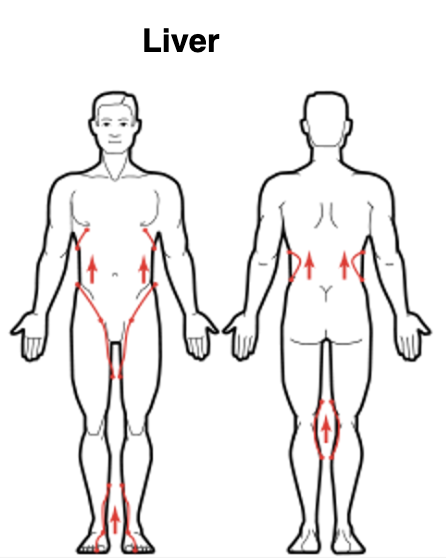
The liver meridian originates at the inside of the big toe. It runs along the instep of the foot and up the inner leg. At the hip, it dips toward the genitals before ascending. At the lower abdomen, the liver meridian zags out and up to the ribs before moving back to the center and ascending to its endpoint at the nipple.
The Gallbladder Meridian
| Attribute | Traditional association |
|---|---|
| Element | Wood |
| Sense Organ | Eyes |
| Sense | Sight |
| Tissue | Tendons |
| Positive Emotion | Kindness |
| Negative Emotion | Anger |
| Flavor | Sour |
| Color | Yellow Green |
| Sound | Shouting |
| Smell | Scorched |
| Time | 11 p.m. -1 a.m. |
| Opposite | Heart |
| Yin/Yang | Yang |
| Flow Direction | Down |
| Origin/Ending | Face to Foot |
| Number of Acupoints | 44 |
Traditional description and pathway
The gallbladder meridian can be seen almost as the body’s janitor. This is not an insult as the ancient Chinese called it the “Honorable Minister.” The gallbladder secretes bile to aid in digestion for muscular energy and works with the lymphatic system to clear out lactic acid. It follows that the gallbladder meridian is, in part, responsible for muscular health.
The gallbladder meridian is responsible for daring and decisive mental states. The aphorism “a lot of gall,” reflects this belief even in ancient Western cultures.
An imbalance in the gallbladder meridian generates more mental afflictions than physical. Such an imbalance to lead to insomnia and stiffness of the muscles. It can also cause poor judgment, timidity, and indecision.
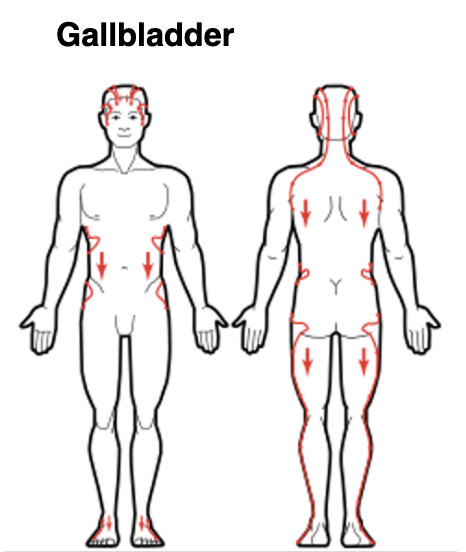
The gallbladder meridian begins on the outer corner of the eye. It zig-zags up and down above the ear and over the eye before running down the back of the skull. It descends down the side of the body, continuing down the outside of the leg, and ends on the outer edge of the 4th toe.
The Pericardium Meridian
| Attribute | Traditional association |
|---|---|
| Element | Fire |
| Sense Organ | Tongue |
| Sense | Touch |
| Tissue | Vessels |
| Positive Emotion | Joy |
| Negative Emotion | Arrogance |
| Flavor | Bitter |
| Color | Purple Red |
| Sound | Laughter |
| Smell | Scorched |
| Time | 7 p.m. – 9 p.m. |
| Opposite | Stomach |
| Yin/Yang | Yin |
| Flow Direction | Up |
| Origin/Ending | Chest to Hand |
| Number of Acupoints | 9 |
Traditional description and pathway
While not an organ, the pericardium corresponds to an actual part of the body. The pericardium is a protective sack encircling the heart. It also assists the triple-heart warmer with its functions. It is one of the two Principal meridians not associated with a major organ. Its protection extends beyond the physical to include the mental, emotional, and spiritual.
It is also responsible for regulating the circulation of the blood. The pericardium meridian also links the emotional feelings of love with the physical act of sex.
Imbalances can cause problems with the heart, chest, stomach, and mind. Imbalances with the pericardium meridian are often caused by extreme, sustained outbursts of emotion.
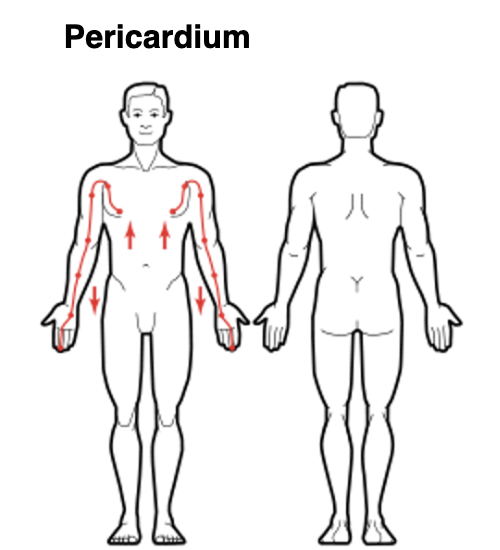
This meridian begins in the middle of the chest and descends to the diaphragm. It also branches out from the chest and runs along the interior of the arm, ending at the tip of the middle fingernail.
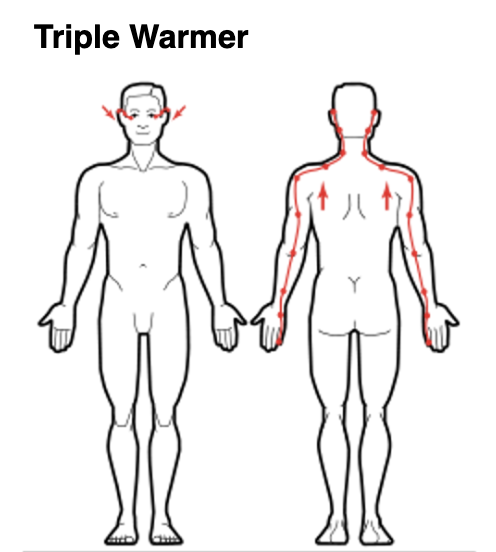
The Triple Warmer Meridian
| Attribute | Traditional association |
|---|---|
| Element | Fire |
| Sense Organ | Tongue |
| Sense | Touch |
| Tissue | Vessels |
| Positive Emotion | Joy |
| Negative Emotion | Arrogance |
| Flavor | Bitter |
| Color | Orange Red |
| Sound | Laughter |
| Smell | Scorched |
| Time | 9 p.m. – 11 p.m. |
| Opposite | Spleen |
| Yin/Yang | Yang |
| Flow Direction | Down |
| Origin/Ending | Hand to Face |
| Number of Acupoints | 23 |
Traditional description and pathway
The Triple-Warmer or Triple-Burner Meridian is the second primary meridian not associated with an organ. Still, it is similar to the thyroid in that it controls the metabolism. It is not strictly limited to the energetic metabolism, though. It is also involved in digestion and waste processing.
As the name suggests, there are three parts to the triple warmer: the upper, middle, and lower. The upper warmer runs from the base of the tongue to the stomach. It controls the bodily intake of food, water, and oxygen. The middle burner starts at the stomach and ends at the pyloric valve. It is responsible for digestion and transformation for use by the body. The lower burner then splits, ending at the anus and urinary tract. It handles the elimination of waste.
When out of balance, disorders with the sense organs and side of the head can occur.
The triple-warmer’s meridian begins at the tip of the ring finger. It runs up the back of the arm and crosses the trapezius, ending at the collarbone.
Other Extraordinary Meridians
The Penetrating Meridian (Chong Mai)
Traditional description and pathway
The Chong Mai, also called the Penetrating Vessel, originates in the space between the kidneys, along with Extraordinary Vessels Du Mai (Governing Vessel) and Ren Mai (Conception Vessel). Its internal branch descends through the uterus and emerges in the perineum. Its descending branch flows down the inner leg to the medial foot and big toe. Meanwhile, its abdominal branch flows upward through the abdomen, following the kidney meridian, and spreads out throughout the abdomen and chest. The head branch further extends through the throat, chin and eyes. The spinal branch flows along with the Du Mai up the spine.
Chong Mai is one of the most important Extraordinary Vessels, and some texts place it as the nexus of the whole Extraordinary Vessel network. It has numerous branches throughout the body and has even more physiological and energetic functions.
The Chong Mai is called the “Sea of Blood,” making it incredibly important in treating gynecological conditions. It is said to transform kidney essence into menstrual blood, and plays a key role in maintaining healthy menstruation. Particularly concerned with adequate movement of blood throughout the body, it can be used to treat any sort of blood stasis pattern, including certain gynecological, circulatory, musculoskeletal and hormonal pathologies. The Chong Mai is particularly linked to heart blood, through its action of dispersing through the chest. Therefore, the Chong Mai is related to heart rhythm, cardiac function and emotional issues such as anxiety and panic attacks.
Chong Mai helps to keep energy and blood moving throughout the whole body – when there is stagnation or pain, the Chong Mai isn’t functioning optimally. By maintaining flow throughout the primary channels, the Chong Mai also is closely tied to the correct directional flow of energy in each system. The Chong Mai also has a close relationship with the stomach, so for nausea as well as other stomach symptoms, treating the Chong Mai can help.
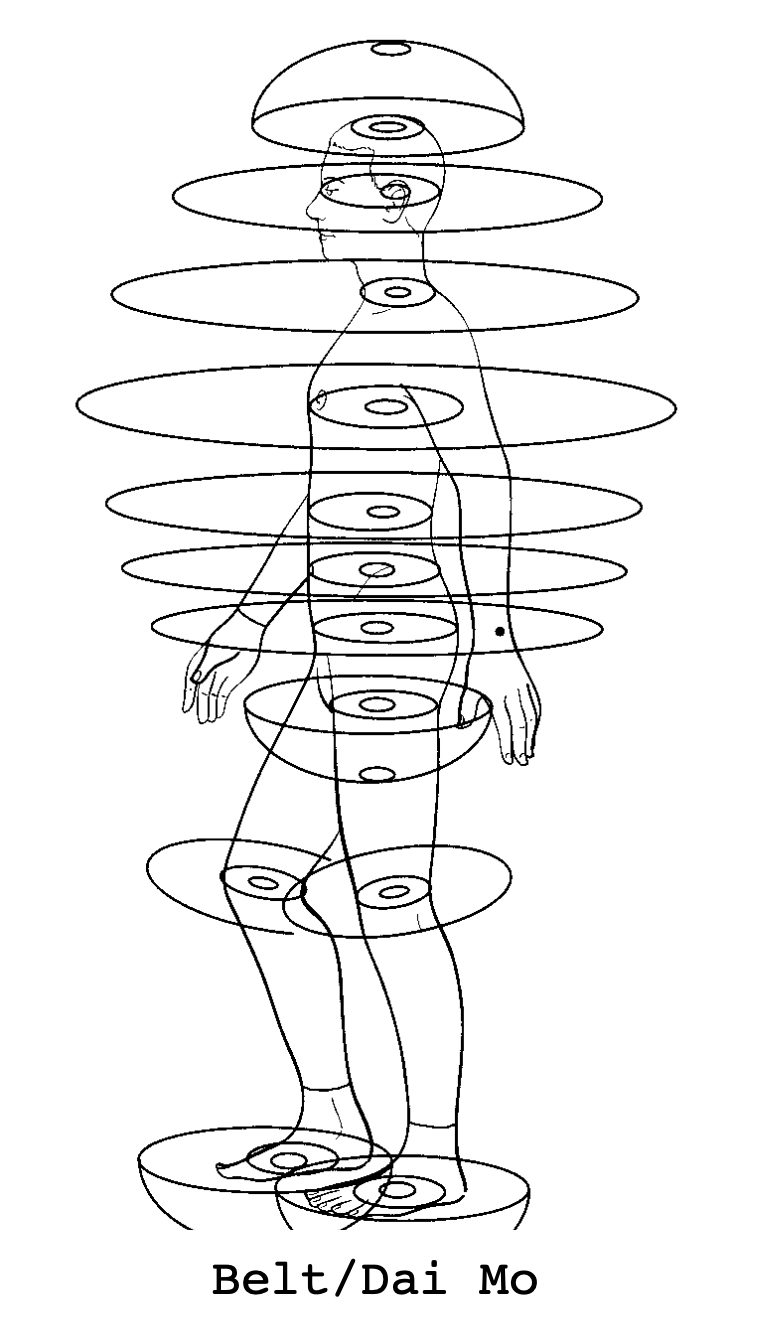
The Girdle Meridian (Dai Mai)
Traditional description and pathway
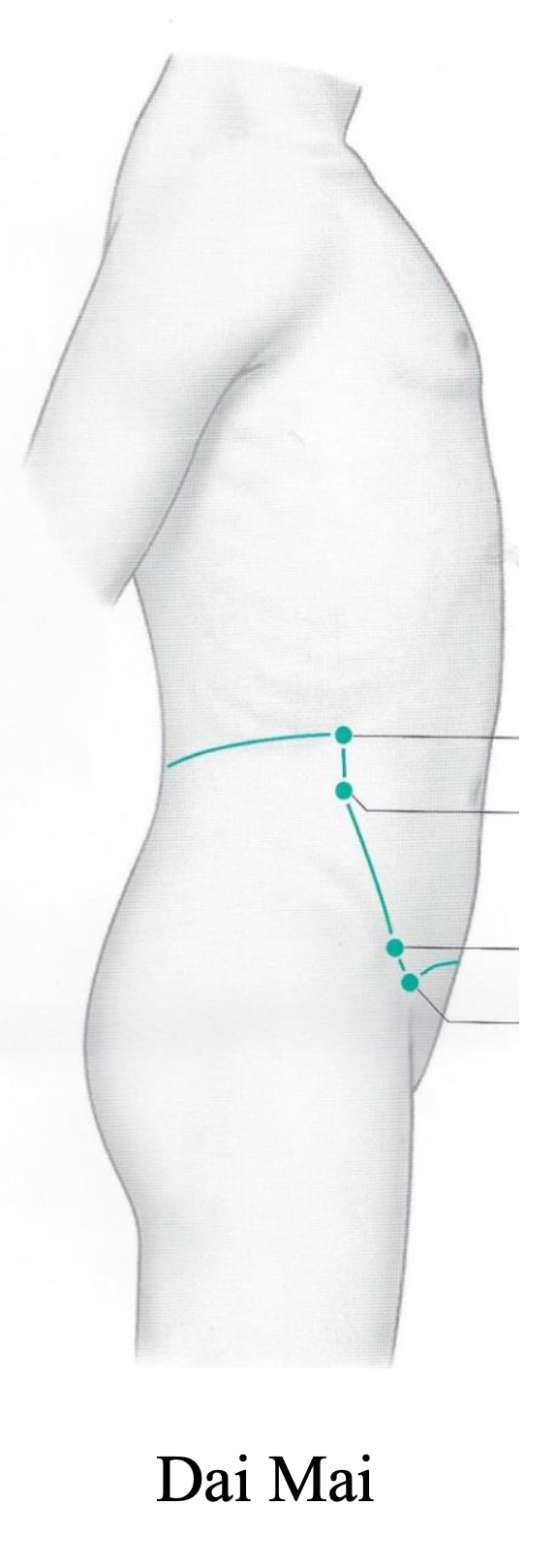
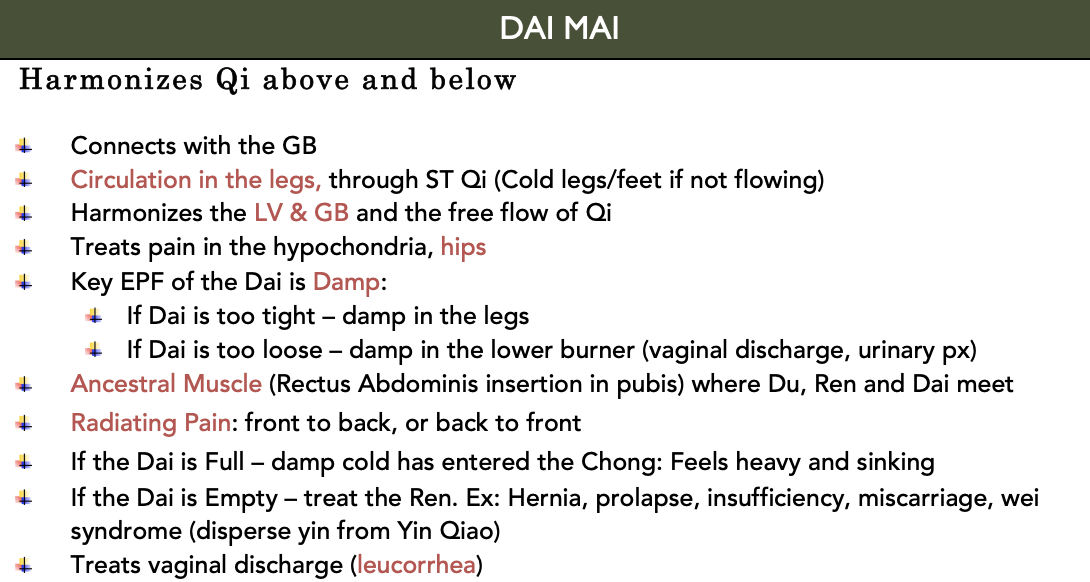
The Dai Mai, or Girdle Vessel is unique because it is the only channel – primary or extraordinary – that flows horizontally. The Dai Mai originates at a liver meridian point on the lateral ribs, descends to the waist line and then encircles the waist like a belt. In the back, it connects with a side branch of the kidney meridian.
The Dai Mai divides the body into two halves, and it has the essential function of keeping energy flowing effectively between those two halves. If the Du Mai is too tight, then energy can’t flow properly, causing pain, sluggishness or a feeling of heaviness through the whole body. It can also cut off energy circulation to the legs, causing pain, cold legs and tense outer leg muscles.
If the Dai Mai is slack or weak, then energy can’t rise properly, which can cause many different health problems. When the Dai Mai is too weak or loose, fluids and dampness can pool in the Lower Burner, causing symptoms such as difficult urination, cloudy urine and excessive vaginal discharge. A weak Dai Mai also means energy can’t flow properly into the channels of the legs, leading to muscle weakness and atrophy. When the Dai Mai is weak, it can’t adequately hold the kidney’s essence, which depletes many other Extraordinary Vessels. When the Dai Mai is slack, energy cannot rise through the body, leading to such problems as hernias, organ prolapse and recurrent miscarriages.
The Dai Mai is closely related to the liver and gallbladder energy systems, based on its trajectory and what points it overlaps with. It helps to regulate excessive energy in those systems. This makes it useful for treating symptoms such as temporal headaches, migraines, anger, gallbladder pain and chronic neck and shoulder tension.
Based on its pathway, the Dai Mai can also be used to effectively treat abdominal pain, low back pain and hip pain. It can be treated with acupuncture, Chinese herbal medicine, tai chi, qi gong and many other forms of exercise.
Other Extraordinary Meridian References
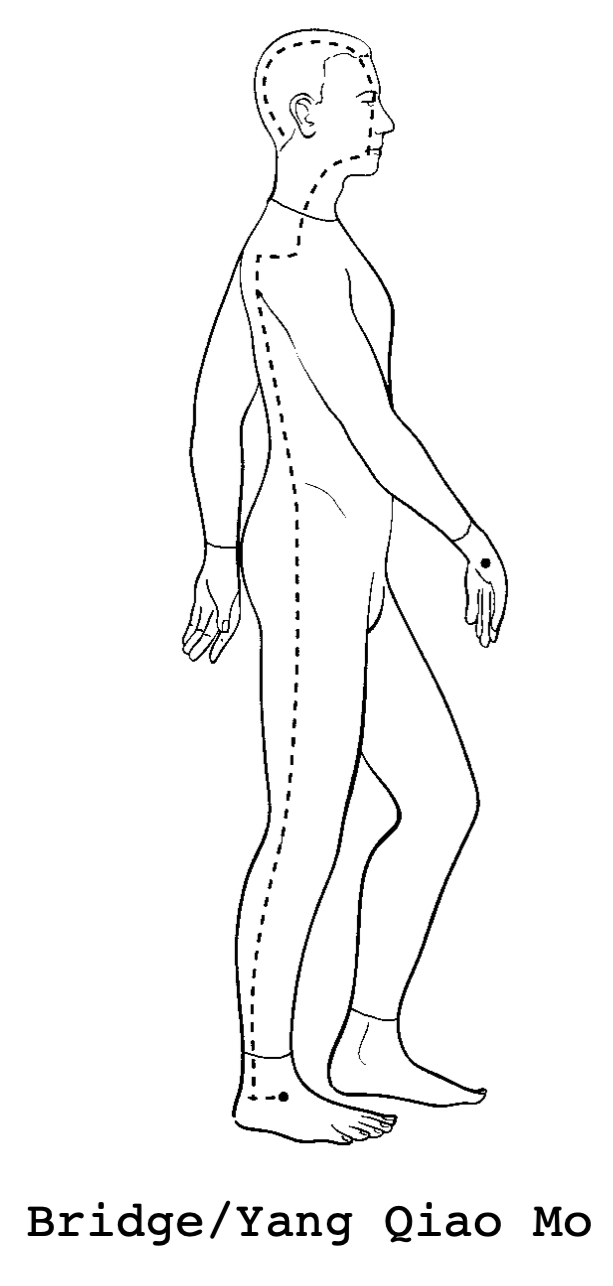
The Yang Heel Meridian (Yang Qiao)
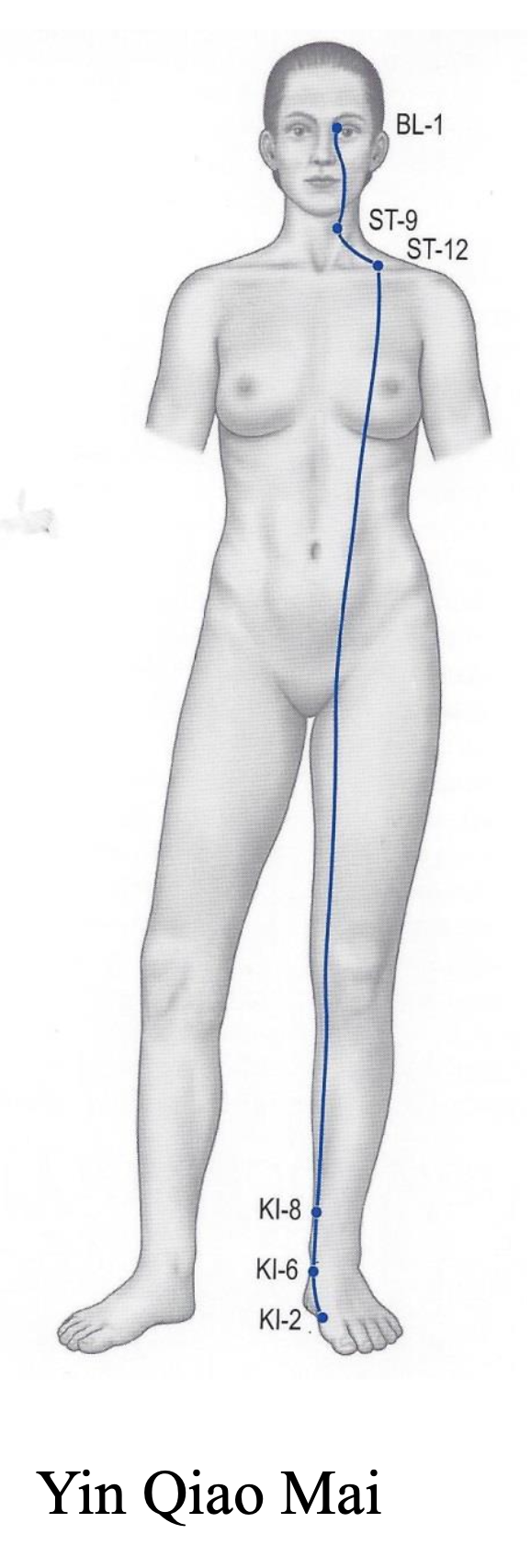
The Yin Heel Meridian (Yin Qiao)
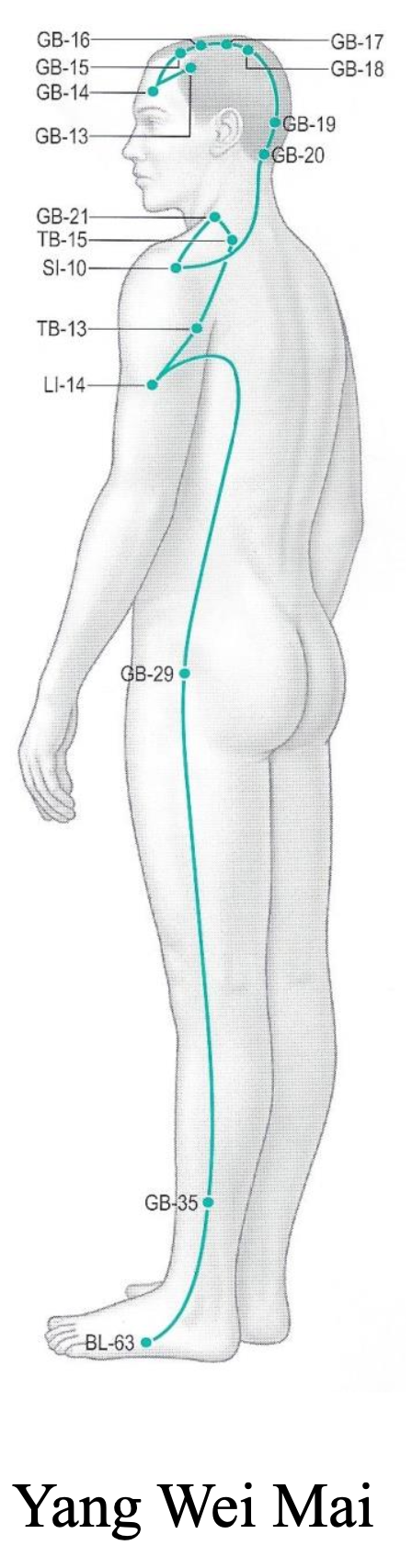
The Yang Linking Meridian (Yang Wei)
The Yin Linking Meridian (Yin Wei)
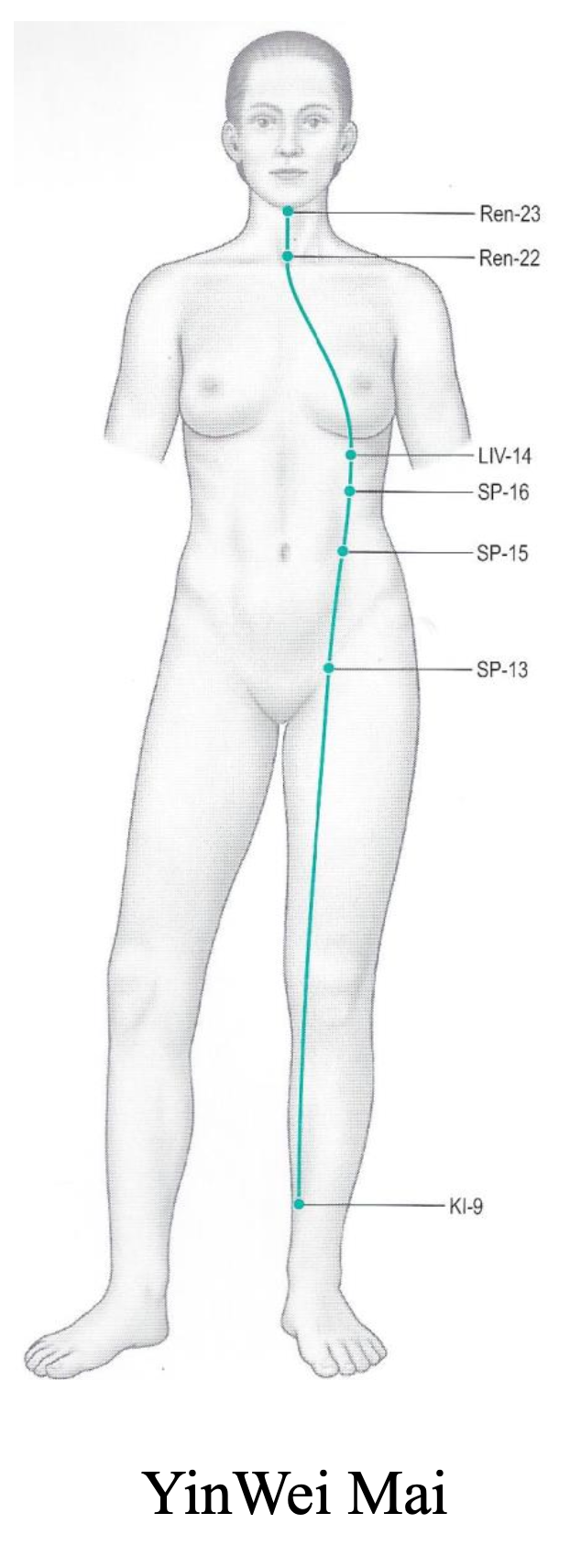
The following names and the Yang Heel visual are included as traditional reference points in this guide.
Related VIGEO Reading
- What Is Healing with Voltage?
- How Does the Cancer and Polarity Framework Describe Voltage?
- What Is Scalar Energy in VIGEO’s Voltage Framework?
- What Is Muscle Testing?
Questions About Body Meridians
Q: What are body meridians?
A: In the traditional acupuncture framework presented here, body meridians are pathways used to describe the movement of energy through the body. The framework includes twelve principal meridians and eight extraordinary meridians.
Q: How many principal meridians are there?
A: This guide describes twelve principal meridians. Most correspond with a major organ, travel through a hand or foot, and are described as moving either up or down the body.
Q: What are extraordinary meridians?
A: The article describes eight extraordinary meridians as reservoirs of energy in relation to the principal meridians. They include the Conception, Governing, Penetrating, Girdle, Yang Heel, Yin Heel, Yang Linking, and Yin Linking meridians.
Q: Is the Meridian System the same as Western anatomy?
A: No. This page presents a traditional, holistic acupuncture model that uses its own vocabulary for voltage, flow, organs, and elemental associations. It is distinct from the reductive Western biological model.