

The Conscious 1% and Subconscious 99%
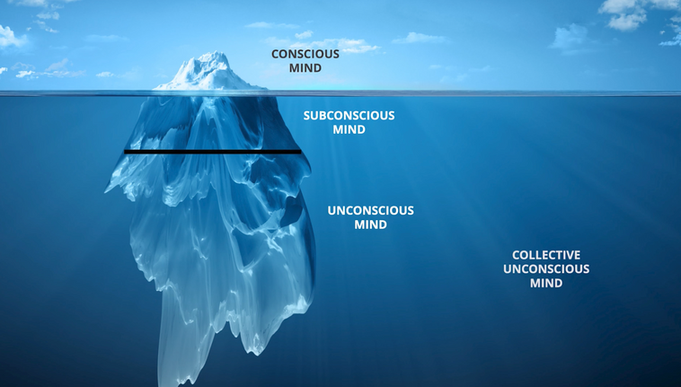
I use the 1% / 99% idea as a simple teaching tool. The exact percentages are less important than the difference between what we consciously notice and everything the body is processing outside conscious awareness.
Our bodies continuously manage heart rate, breathing, digestion, hormone signaling, temperature, balance, movement, sensory information, immune activity, memories, emotional responses, learned patterns, and thousands of other processes without our consciously directing them.
A single cell is extraordinarily complicated, almost like a tiny aircraft carrier with thousands of jobs happening at once. Our bodies contain trillions of cells coordinating activity all the time. We consciously direct almost none of it. This complexity is one rationale for considering muscle testing as an additional source of information.
Muscle Testing and Applied Kinesiology
Applied Kinesiology developed from the work of chiropractor Dr. George Goodheart beginning in the 1960s. The International College of Applied Kinesiology describes it as an interdisciplinary approach that combines manual muscle testing with other clinical assessments.
Energetic yes/no testing, sway testing, pendulum testing, Emotion Code testing, and Dr. Jerry Tennant’s meridian testing are related applications, but they are not necessarily identical to professional Applied Kinesiology.
What does research say about reliability?
Research on manual muscle testing and Applied Kinesiology is specific to the procedure being studied. A 2025 systematic review found that reliability of Applied Kinesiology manual-muscle-test procedures ranged from nonexistent to very strong depending on the muscle, analysis, and whether an additional challenge procedure was used. The review reported that nonmusculoskeletal challenge procedures did not show reliable results in the included studies, while some unchallenged manual tests showed moderate-to-very-strong reliability for particular muscles. Read the review on PubMed.
That distinction matters: research on a particular muscle-strength test is not the same thing as research validating every energetic, meridian, challenge, or diagnostic application. I use muscle testing as one source of information alongside client history, observations, measurement, physiology, and judgment.
How Can I Learn Muscle Testing?
Start with a method that feels comfortable, use questions with answers you already know, and practice until the response becomes familiar. Dr. Bradley Nelson’s Discover Healing muscle-testing resource also offers an overview of the self, partner, and proxy approaches taught within that system.
Outstretched Arm Test
Establish a comfortable, consistent arm position and a gentle, repeatable amount of resistance. Ask a simple yes/no question and notice the change in the response rather than forcing strength.
Watch demonstration →Sway Test
Stand comfortably, ask a clear yes/no question, and observe whether your body naturally sways forward or backward. Begin with statements you know are true or false.
Watch demonstration →Ring-in-Ring Test
Make two linked finger rings, establish a consistent amount of tension, and use simple questions while observing whether the rings remain connected or release.
Learn the method →Pendulum Testing
Use a pendulum as an observable response tool. Begin by learning what your own yes and no responses look like before asking anything more complicated.
Watch demonstration →Practice With Questions You Already Know
When you are learning, begin with something obvious:
- “My name is Dawn.”
- “My name is George.”
- “YES.”
- “NO.”
The purpose initially is not to diagnose anything or solve a complicated problem. It is to learn what a consistent strong/weak, forward/backward, or yes/no response feels like.
Ask Better Questions
Useful questions are generally:
- Simple
- Specific
- Yes/no
- About one issue at a time
- Asked without consciously trying to force the answer
Instead of asking, “What supplements should I take?” ask, “Would this supplement be beneficial for me today?” Instead of asking one huge question such as “Why does my knee hurt?” break the possibilities into individual questions.
What Can I Ask?
Examples include:
- “Would this supplement be beneficial for me today?”
- “Is this something I should investigate further?”
- “Is my chronic left knee pain related to an emotional imbalance?”
- “Is this meridian testing normally?”
- “Is there another underlying imbalance I should investigate?”
Use curiosity and investigation. A muscle-testing response is not the end of the inquiry.
What Shouldn’t I Ask?
Do not use muscle testing for lottery numbers or to predict the future. People should not become dependent on muscle testing for every small decision. Use it as a tool; do not surrender your judgment to it.
If you repeatedly ask the same question until you finally receive the answer you wanted, you are probably no longer listening to your body anyway.
Could Chronic Pain Have an Emotional Component?
Dr. Bradley Nelson, creator of The Emotion Code, has stated that he believes approximately 90% of chronic physical pain has an emotional component or is associated with trapped emotional energy. That is Nelson’s teaching and estimate, not a population statistic established by conventional pain research.
This concept is one reason I use muscle testing when exploring persistent pain. If someone has chronic knee pain, for example, I may test whether there appears to be an emotional component worth exploring rather than assuming the problem is purely structural.
Can I Muscle Test Another Person?
Emotion Code, Body Code, Belief Code, and other energetic systems use proxy or surrogate testing. Permission matters. When testing another adult, child, or animal, appropriate permission should be obtained from the individual, parent or guardian, caregiver, or animal owner.
Troubleshooting Muscle Testing
What if I can’t get a clear answer?
- Hydration: Drink some water and try again.
- Relaxation: Do not strain or force the response.
- Question wording: Ask one simple yes/no question.
- Expectation: Try not to consciously decide what answer you want.
- Practice: Use questions with known answers until the response becomes familiar.
- Try another method: If the arm test is unclear, try sway testing, ring-in-ring, or a pendulum.
- Stop chasing the answer: If you keep asking the same question until you get the answer you wanted, stop and come back later.
How I Use Muscle Testing at VIGEO
I use muscle testing within Emotion Code, Body Code, Belief Code, meridian work, energetic assessment, supplement questions, and exploration of relationships between symptoms and possible underlying imbalances.
Muscle testing gives me another source of information to consider alongside the rest of what I know about a client. My broader VIGEO approach remains:
How Can I Test My Meridians?
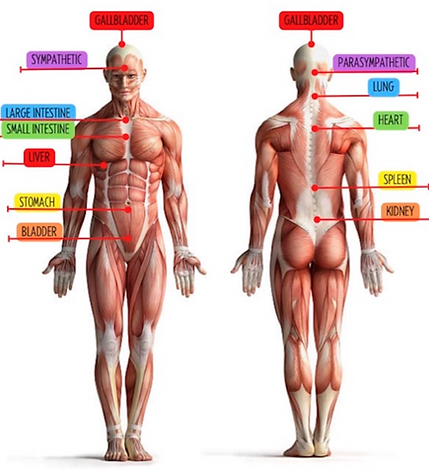
This method comes from Dr. Jerry Tennant’s Healing Is Voltage framework. Tennant teaches that the body’s acupuncture meridians function as electrical circuits and describes methods of evaluating their polarity and voltage.
Within this framework, muscle or pendulum testing can be used to explore whether individual meridian circuits appear to be functioning normally. The source locations I use as reference points are:
| Circuit | Reference location |
|---|---|
| Gallbladder | Crown of head |
| Autonomic nervous system | Forehead just above eyebrows |
| Lung / Large Intestine | Indentation at bottom of neck |
| Heart / Small Intestine | Center of chest |
| Stomach / Spleen | Several inches above belly button |
| Bladder / Kidney | Several inches below belly button |
| Liver | Inside of knee |
Questions About Muscle Testing
What is muscle testing?
Muscle testing is a way of asking a simple question and observing a physical response such as strength, sway, finger release, or pendulum movement.
Is muscle testing the same as Applied Kinesiology?
Not necessarily. Applied Kinesiology is a specific professional system. The methods discussed here include practical yes/no, sway, pendulum, Emotion Code, and meridian-testing applications.
Can anyone learn muscle testing?
Yes. Start with one method, questions with known answers, and consistent practice.
Can I use muscle testing for supplements?
You can ask simple questions such as whether a supplement may be beneficial to investigate further. Use that information as one part of your thinking, not as a replacement for judgment or appropriate clinical care.
How does Dawn use muscle testing at VIGEO?
I use it as an energetic feedback tool within Emotion Code, Body Code, Belief Code, meridian work, supplement questions, and broader exploration of client patterns.