

What is cagrilintide?
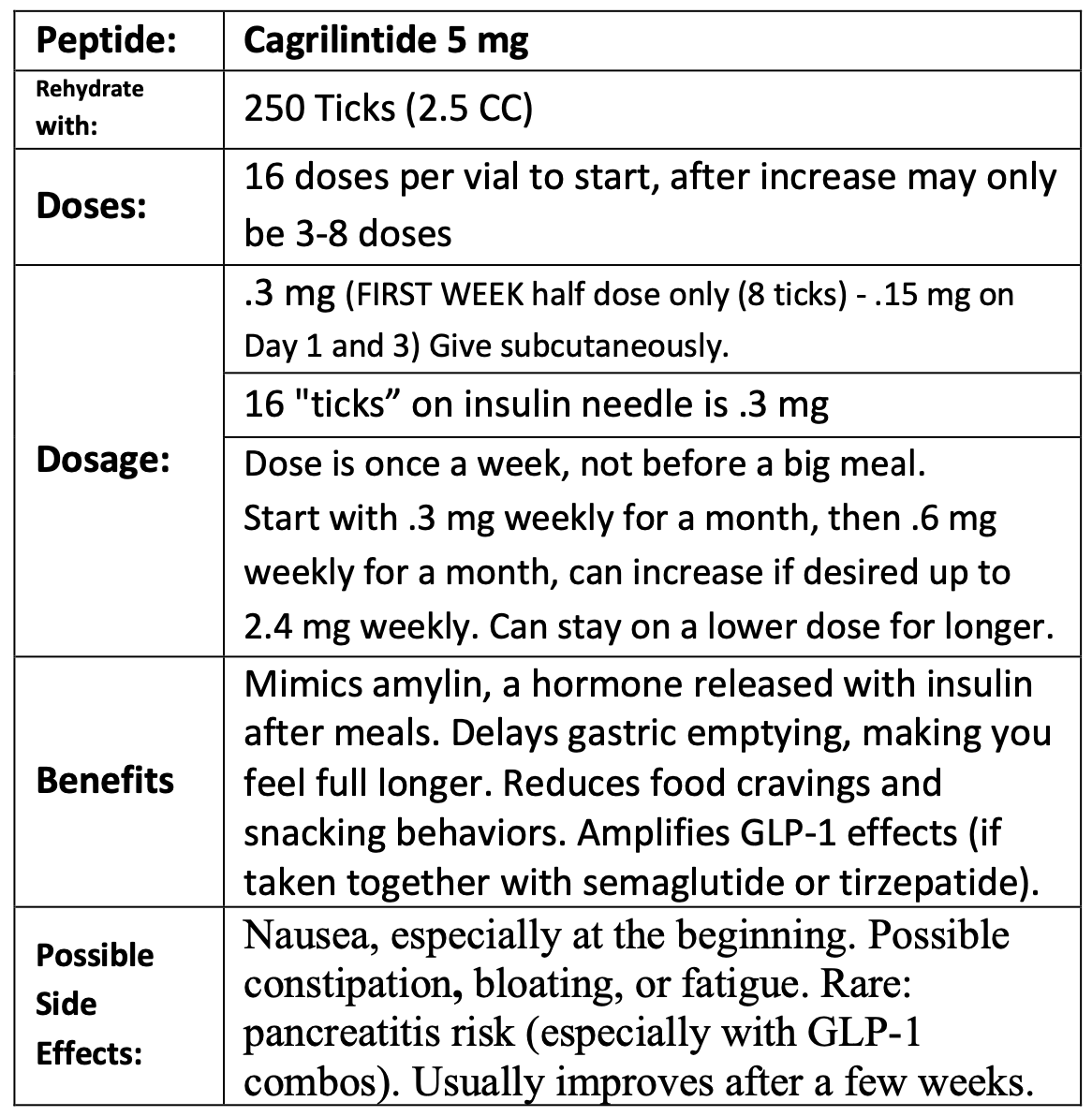
An amylin analogue. Amylin is a hormone released alongside insulin after meals, and it is part of how the body signals fullness.
Cagrilintide mimics it:
- Delays gastric emptying, so you feel full longer
- Reduces food cravings and snacking behaviours
- Amplifies GLP-1 effects when taken with semaglutide or tirzepatide
That last point is the reason it exists in this library. Amylin and GLP-1 are different signalling pathways, so combining them addresses fullness from two directions rather than pushing harder on one.
Side effects
- Nausea, especially at the beginning
- Possible constipation, bloating, or fatigue
- Rare: pancreatitis risk, especially with GLP-1 combinations
Usually improves after a few weeks.
Because the main use case is combination with a GLP-1, the risks of that class apply too: gallbladder disease, severe gastroparesis, and hypoglycaemia for anyone on insulin or a sulfonylurea. Combining two compounds that both delay gastric emptying compounds that specific effect.
Do your own research.
Sourcing and quality
Peptides sold outside compounding pharmacies are labelled "Not For Human Consumption and For Research Use Only." Always ask for batch-specific third-party testing.
VIGEO Health does not sell injectable peptides. Email dawn@vigeohealth.net.
Test your foundations first
Eating substantially less means taking in fewer minerals at exactly the point tissue turnover accelerates. That is true of every compound in this category and it is the reason to know your baseline before starting rather than after symptoms appear.
See what the OligoScan measures
What this page does not tell you
- Cagrilintide is not approved. It is investigational, studied largely in combination with semaglutide.
- The combination is where most of the trial data sits, not cagrilintide alone.
- Anyone on diabetes medication needs supervision.
- Not appropriate in pregnancy.
- Rapid weight loss includes lean mass. Protein intake and resistance training change what is lost.
- Long-term safety data does not exist.
Related
Questions and Answers
Q: How is cagrilintide dosed? A: Once weekly, subcutaneously. The first week is a half dose of 8 ticks, 0.15 mg, on days 1 and 3. Then 0.3 mg weekly, which is 16 ticks, for a month, followed by 0.6 mg weekly for a month, increasing up to 2.4 mg weekly if desired. It should not be dosed before a large meal.
Q: What does cagrilintide do? A: It mimics amylin, a hormone released alongside insulin after meals. It delays gastric emptying so you feel full longer, and reduces food cravings and snacking behaviours. Taken together with semaglutide or tirzepatide it amplifies GLP-1 effects.
Q: What are the side effects of cagrilintide? A: Nausea, particularly at the beginning, along with possible constipation, bloating or fatigue. These usually improve after a few weeks. Pancreatitis is a rare risk, especially in combination with GLP-1 compounds.