

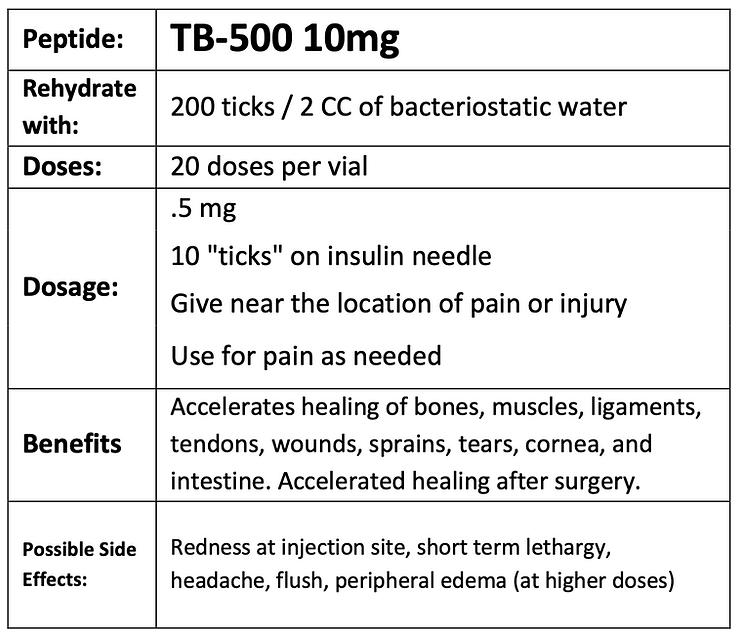
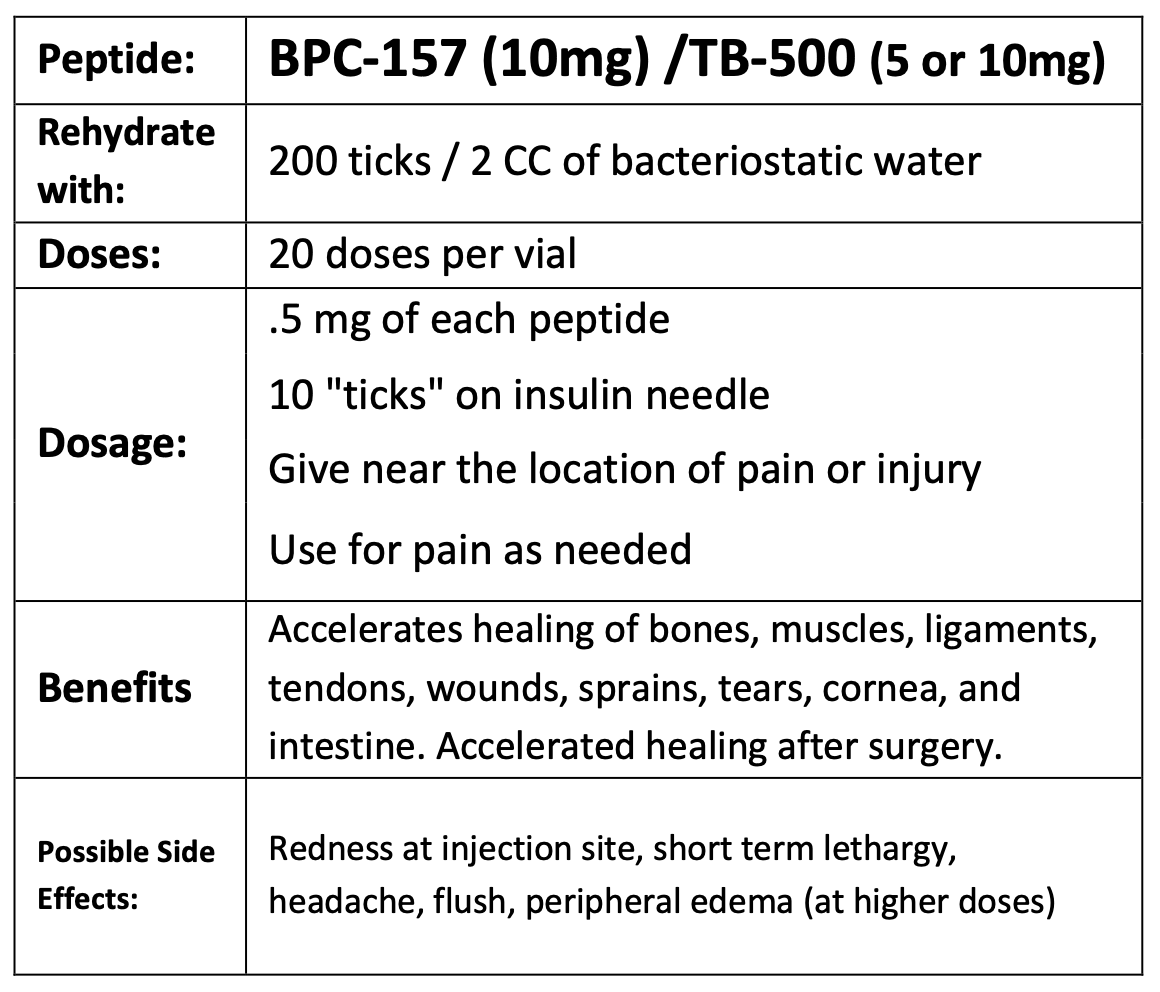
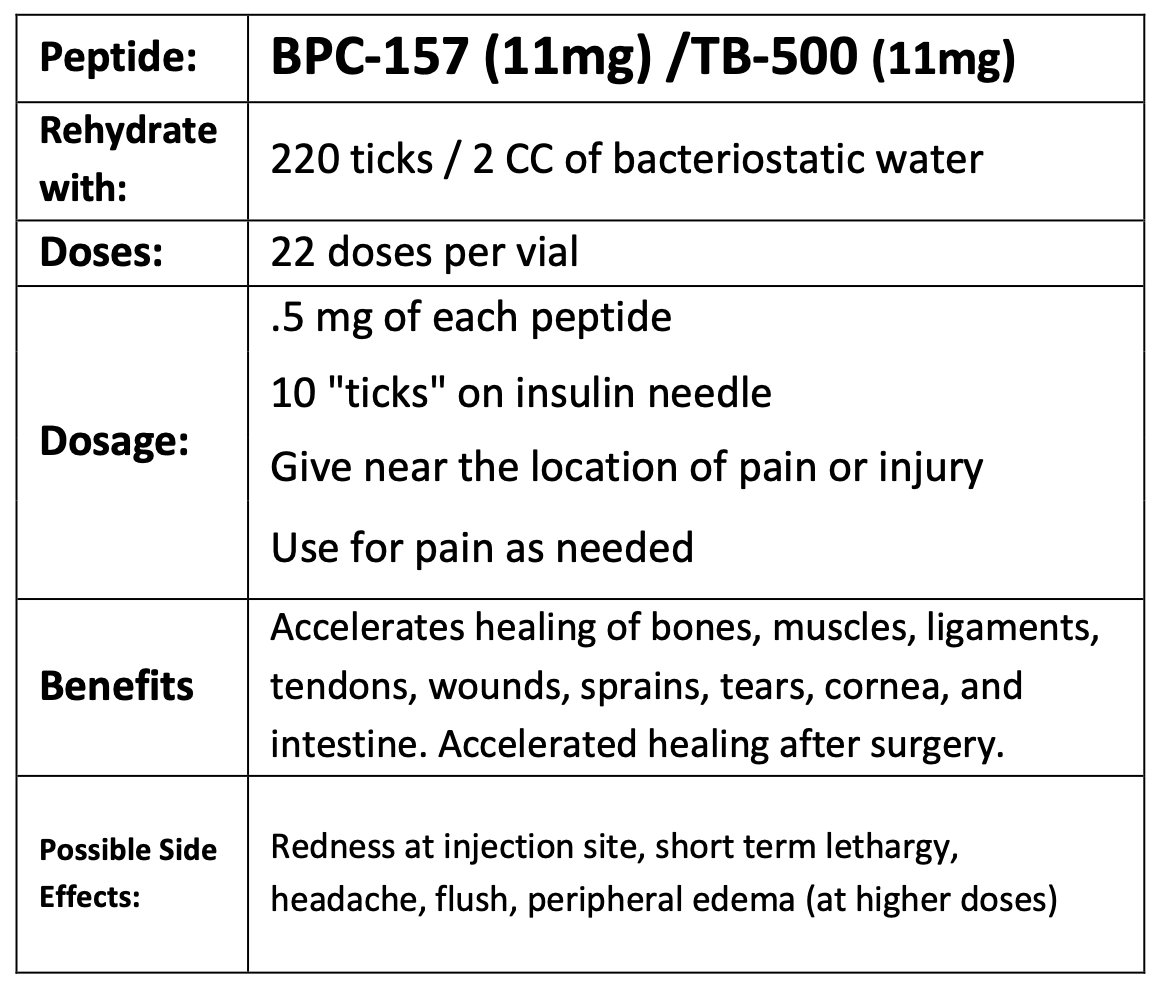
What is TB500?
TB500 is the four amino acid fragment (1-4) of the 43 amino acid full-length Thymosin Beta 4 (TB4), produced by the thymus gland.
TB4 has multiple active sections coding for different and overlapping functions. TB500 is the workhorse, carrying the immune modulatory, angiogenic, healing, anti-inflammatory, cell-protective and repair actions of the full-length protein.
TB500 is arguably better than full-length TB4
| Why | |
|---|---|
| More potent anti-fibrotic | Reduces scarring more effectively |
| 10x the potency by weight | Compared with full-length TB4 |
| Does not stimulate mast cell activation | That function sits in segment 16-38, which TB500 does not include |
| Crosses the blood-brain barrier | Reduced molecular weight allows it |
| Penetrates biofilms | Same reason |
How does it work?
Through actin. Actin is a cell-building protein responsible for the action and formation of most cells in the body, and it is essential to healing and wound repair.
TB500 regulates actin and speeds up the process by which it builds cells. It also enhances stem cell differentiation, increases cell mobility, and improves cell survival. The result is accelerated positive cell growth in injured areas.
Its effects run through three routes: blood cell and blood vessel development, cellular differentiation, and cell migration.
What is it studied for?
Musculoskeletal
- Improved musculoskeletal, joint and wound repair
- Increased endurance and strength
- Improved muscle tone
- Suppressed muscle spasms
- Reduced joint inflammation
- Faster wound healing with less pain and less tissue scarring
Immune and inflammatory
- Excellent immune modulator
- Optimises response from T-killer cells and lymphocytes
- Lowers chronic inflammation
- Suppresses inflammatory IL-8 and TNF-alpha
- Improved autoimmune function
- Antimicrobial, anti-inflammatory, anti-apoptotic
Neurological
- Used in patients with traumatic brain injury and stroke
- Regenerates damaged cells
Other
- Protects heart tissue during cardiac events
- Protection against oxidative damage, and increases oxidative enzymes
- Helps prevent hypercoagulability seen with chronic illness
- Potential antiviral effects; one study showed a major reduction in influenza symptoms with Thymosin Beta-4
- Improved chronic fatigue
- Speeds up hair growth
- Up-regulates hepatocyte growth factor, down-regulates platelet-derived growth factor
The tumour cell question
Worth pulling out of the benefits list and addressing directly, because it appears there as a technical note and deserves more than that.
TB500 promotes migration of cells, including stem cells and tumour cells, via G-actin sequestering. That is Dawn's own wording and it is accurate: the actin mechanism that drives healthy cell migration is not selective.
What that means practically. Anyone with an active cancer, a cancer history, or an undiagnosed lump should not be using TB500 without an oncologist's involvement. A compound that accelerates cell migration and blood vessel formation is not neutral in that context.
This is not a reason to avoid TB500. It is a reason to know your situation first.
How does TB500 differ from BPC-157?
They are frequently used together, and they divide the work.
| TB500 | BPC-157 | |
|---|---|---|
| Mechanism | Actin regulation, cell migration | Angiogenesis, growth factor upregulation |
| Reach | Systemic, concentrates at injury sites | Systemic, oral acts locally in the gut |
| Particular strength | Tight junction repair, anti-fibrotic, neurological | Tendon-to-bone, gut lining, cardiovascular |
Together with KPV, these three are the combination most often used for EMF-induced leaky gut, leaky brain, and gut-brain axis dysfunction. TB500 directly repairs tight junction dysfunction; BPC-157 and KPV maintain and protect GI mucosal and blood-brain barrier integrity.
Side effects and warnings
Side effects: less than placebo when dosage is administered correctly.
Some people report a head rush immediately following injection, lasting a few minutes.
Elite athletes: TB500 is banned by WADA. If you compete in a tested sport this will fail a test. Check the current prohibited list. The responsibility is yours and the penalties are serious.
Do your own research.
Regulatory status, updated
The FDA currently lists the TB4 fragment (LKKTETQ) among bulk drug substances that may present significant safety risks in compounding, citing limited human exposure and safety data. Separately, TB-500 is under FDA review for possible inclusion on the 503A Bulk Drug Substances List, which if granted would create a clearer legal pathway for compounding pharmacies.
Read that as movement, not resolution. It means the compound is being taken seriously enough to review. It does not mean it has been cleared.
Most published evidence remains from animal models and cell culture rather than human trials.
Sourcing and quality
Peptides sold outside compounding pharmacies are labelled "Not For Human Consumption and For Research Use Only." Always ask for batch-specific third-party testing. If it is not available, go elsewhere.
VIGEO Health does not sell injectable peptides. Third-party vendors can be recommended on request: email dawn@vigeohealth.net.
Test your foundations first
TB500 signals tissue to rebuild. Rebuilding consumes minerals: zinc for tissue repair, copper for connective tissue and blood vessel formation, magnesium for the enzymes doing the work. Signalling for construction without the materials produces a poor return on an expensive compound.
See what the OligoScan measures
What this page does not tell you
- TB500 is not an approved medication. It is sold as a research compound outside pharmaceutical manufacturing standards.
- Most evidence is preclinical. Animal models and cell culture dominate. Human trial data is limited.
- The cancer consideration above is real and warrants an oncologist's involvement rather than a judgement call.
- The cardiac and neurological findings are research observations, not claims about what will happen to you. Heart conditions and brain injury require medical care.
- Long-term safety data does not exist.
- Prohibited in tested sport.
References and further reading
- Greenfield, Ben. How to use TB-500. bengreenfieldlife.com
- Thymosin Beta 4 as a restorative and regenerative therapy for neurological injury and neurodegenerative diseases
- Thymosin β4 promotes the recovery of peripheral neuropathy in type II diabetic mice
- Goldstein, A.L. and Kleinman, H. Thymosin beta-4 in wound healing. Annals of the New York Academy of Sciences, 2003.
- FDA bulk drug substances listings and 503A review status.
- VIGEO Health Medical Disclaimer
Related peptides
- BPC-157 — the standard pairing
- KPV — the third of the gut trio
- Testing for athletes
Questions and Answers
Q: How is TB500 dosed? A: Daily, for up to three months or until the condition resolves. A vial provides 10 to 30 doses. It does not need to be injected near the site of injury, because it circulates systemically and concentrates at sites of active repair. Higher doses can be used for a short period.
Q: What is TB500? A: The four amino acid fragment of Thymosin Beta 4, a 43 amino acid protein produced by the thymus gland. TB500 carries the immune modulatory, angiogenic, healing, anti-inflammatory and repair actions of the full-length protein, at roughly ten times the potency by weight.
Q: How does TB500 work? A: Through regulation of actin, the cell-building protein essential to healing and wound repair. TB500 speeds the process by which actin builds cells, enhances stem cell differentiation, increases cell mobility and improves cell survival. Its effects run through blood vessel development, cellular differentiation, and cell migration.
Q: What is the difference between TB500 and BPC-157? A: TB500 works through actin regulation and cell migration, and is particularly noted for tight junction repair, anti-fibrotic effects, and neurological applications. BPC-157 works through angiogenesis and growth factor upregulation, and is noted for tendon-to-bone healing, gut lining and cardiovascular effects. They are frequently used together.