

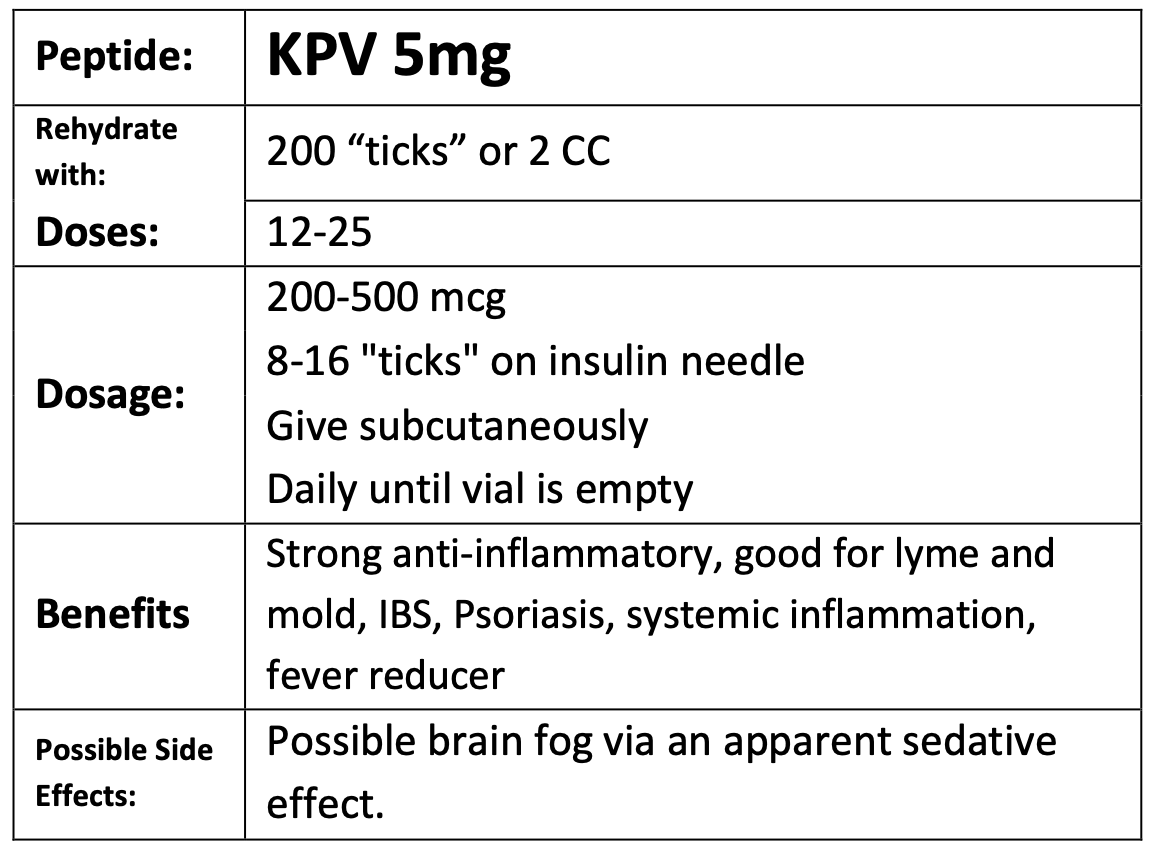
Why open-ended duration is reasonable here. Because of KPV's non-steroidal nature, it does not carry the cumulative-exposure problem that limits steroid anti-inflammatories. That is the argument for using it until the condition is resolved rather than working to a fixed cycle.
What is KPV?
A tripeptide, three amino acids long, making up the end of a naturally occurring melanocortin peptide hormone in your body: alpha-melanocyte-stimulating hormone (α-MSH).
KPV was determined to be the "minimum effective sequence" needed for α-MSH to exert its inflammation-lowering properties. Everything else in the parent hormone can be removed and the anti-inflammatory action remains.
How does KPV work? The mechanism worth understanding
This is the part that makes KPV genuinely unusual, and it is worth the paragraph.
Most anti-inflammatories act at receptors on the cell surface. KPV acts inside the cell. It enters the cell, interacts directly with inflammatory signalling molecules, then enters the nucleus where it inhibits the interaction of inflammatory substances.
Notably, KPV is unlikely to mediate its effects through melanocortin receptors at all. Although it is the active portion of α-MSH, the two target inflammation via similar yet separate mechanisms. KPV appears to act through inhibition of IL-1β function.
Three parts to its mode of action
- Reduces the two most important intracellular signalling pathways in the development of inflammatory bowel disease: the NF-κB and MAPK cascade pathways, along with the subsequent synthesis of pro-inflammatory cytokines.
- Its anti-inflammatory effect is mediated through the transporter PepT1.
- Oral delivery reduces colitis severity in DSS- and TNBS-induced models. Targeting KPV transport into both epithelial and immune cells may reduce overall pro-inflammatory cytokine production by mucosal and immune cells.
That combination is why KPV is described as an attractive therapeutic strategy against IBD.
Gut health
α-MSH is vital in treating inflammatory bowel disease. Two human studies of KDPT, a close analogue, showed beneficial effect on ulcerative colitis without compromising safety. Patients with moderate or severe disease saw the best response, in both remission and symptom relief.
KPV and BPC-157 are the two leaders when it comes to peptides for overall gut health, likely via reduced production of pro-inflammatory compounds.
Skin conditions
α-MSH's anti-inflammatory effects are observed in skin across multiple disease states, including experimentally induced cutaneous vasculitis, experimental psoriasis, experimental autoimmune encephalitis, allergic contact dermatitis, allergic bronchiolitis and colitis.
The primary use case people come to KPV for is psoriasis and eczema, treated from the inside rather than topically.
Breadth of anti-inflammatory action
Studied across five separate animal species (rabbit, mouse, rat, guinea pig, squirrel monkey), in these disease states:
Fever · systemic inflammation · brain inflammation · arthritis · ocular inflammation · contact dermatitis · fibrosis · allergic airway inflammation · acute pancreatitis · gastrointestinal inflammation
Note the species list. That breadth is genuinely striking, and it is also the reason to be careful: this is preclinical work. Effects demonstrated across five animal species are a strong signal, not a substitute for human trials.
Other reported applications
- Antimicrobial: shows promise against Staphylococcus aureus and the fungus Candida albicans
- Immune hair disorders: potential agent for hair loss due to autoimmune conditions
- Anti-HIV properties in infected cells, as shown in cell culture
- Acne: KdPT, a close analogue, may be useful
- Eczema: α-MSH shows promise
- Low α-MSH is observed in Lyme disease, mould illness and arthritis
- Ocular immunity: α-MSH plays a pivotal role, and is under investigation in an ongoing clinical trial
- Colitis-associated cancer: in a mouse study, KPV lowered inflammation and tumorigenesis
Side effects and cautions
Excellent safety profile, even at higher doses.
- Do not use KPV if you are nursing, may become pregnant, or are already pregnant.
- May cause temporary brain fog, via an apparent sedative effect.
Anyone taking immunosuppressive medication should raise KPV with their physician, since adding an anti-inflammatory that works intracellularly to an existing immune-modulating regimen is a combination nobody has studied. And an autoimmune diagnosis is a reason for supervision rather than a contraindication.
Do your own research.
Where KPV fits with BPC-157 and TB500
These three are the combination most often used for EMF-induced leaky gut, leaky brain, and gut-brain axis dysfunction.
| Peptide | Role in the trio |
|---|---|
| TB500 | Directly repairs tight junction dysfunction |
| BPC-157 | Maintains and repairs GI mucosal and blood-brain barrier integrity |
| KPV | Same protective role, working through intracellular inflammation control |
The effect together is strongly synergistic. Each does less alone than the three do together.
Sourcing and quality
Peptides sold outside compounding pharmacies are labelled "Not For Human Consumption and For Research Use Only." Always ask for batch-specific third-party testing. If it is not available, go elsewhere.
VIGEO Health does not sell injectable peptides. Third-party vendors can be recommended on request: email dawn@vigeohealth.net.
Test your foundations first
KPV controls inflammation. It does not remove what is driving it. If the source is a food you are eating daily, a metal burden competing for absorption pathways, or a gut lining that never healed, KPV manages the signal while the cause continues.
That is not an argument against using it. It is an argument for finding out what you are actually dealing with.
See what the OligoScan measures
What this page does not tell you
- KPV is not an approved medication. It is sold as a research compound, outside pharmaceutical manufacturing standards.
- Most evidence is preclinical. The animal work is broad and consistent, but the human data is limited to KDPT analogue studies in ulcerative colitis.
- Contraindicated in pregnancy, possible pregnancy, and nursing.
- Inflammatory bowel disease requires proper medical management. Crohn's and ulcerative colitis can cause serious complications, and this is not a substitute for gastroenterology care.
- Psoriasis and eczema have effective conventional treatments worth knowing about alongside this.
- Long-term safety data does not exist.
References and further reading
- PepT1-Mediated Tripeptide KPV Uptake Reduces Intestinal Inflammation, Gastroenterology
- Literature on α-MSH anti-inflammatory activity and the minimum effective sequence.
- Human studies of KDPT in ulcerative colitis.
- VIGEO Health Medical Disclaimer
Related peptides
- BPC-157 — the other gut leader
- TB500 — completes the trio
- All peptides
Questions and Answers
Q: What is KPV? A: A tripeptide, three amino acids long, forming the end of alpha-melanocyte-stimulating hormone. It was identified as the minimum effective sequence needed for alpha-MSH to exert its anti-inflammatory properties, meaning the rest of the parent hormone can be removed and the anti-inflammatory action remains.
Q: How is KPV dosed? A: Daily until the vial is empty, with vials containing 12 to 25 doses. Because of KPV's non-steroidal nature it can be used for as long as needed until the condition resolves, rather than working to a fixed cycle length.
Q: How does KPV reduce inflammation? A: Unusually, it acts inside the cell rather than at a surface receptor. KPV enters the cell, interacts directly with inflammatory signalling molecules, then enters the nucleus and inhibits inflammatory interactions. It reduces the NF-kB and MAPK cascade pathways, and its effect is mediated through the transporter PepT1. It appears not to act through melanocortin receptors at all.
Q: Is KPV used for psoriasis and eczema? A: It is one of the main reasons people use it. Alpha-MSH's anti-inflammatory effects have been observed in skin across multiple disease states including experimental psoriasis and allergic contact dermatitis, and KPV is used to address these from the inside rather than topically. The evidence is largely preclinical.