

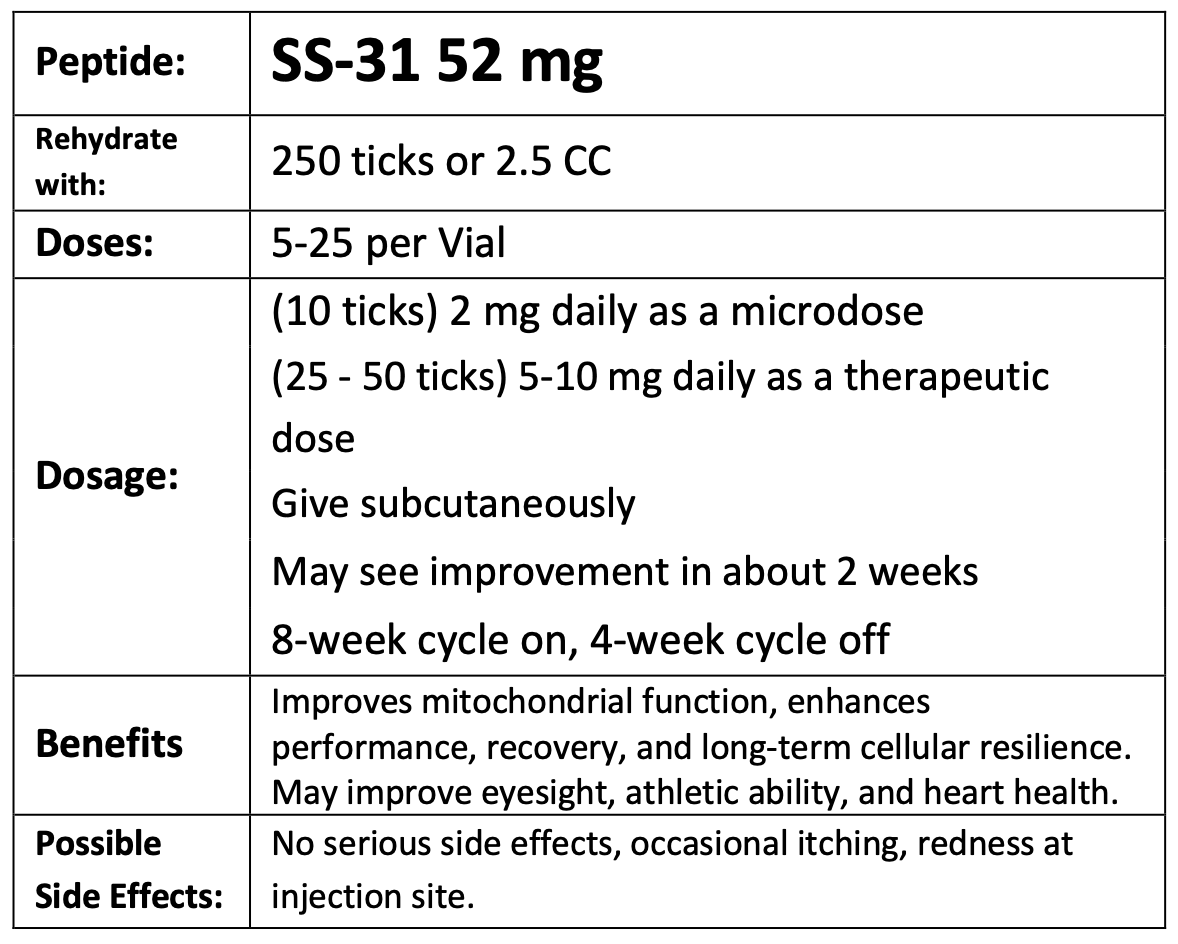
What is SS-31?
A mitochondria-targeted peptide, also known as elamipretide. What makes it unusual is where it goes: it concentrates in the inner mitochondrial membrane, where it associates with cardiolipin, a phospholipid essential to the structure of the electron transport chain.
Most compounds affect mitochondria indirectly, by changing signalling. SS-31 acts on the machinery itself.
What is it studied for?
- Improves mitochondrial function
- Enhances performance
- Enhances recovery
- Supports long-term cellular resilience
- May improve eyesight
- May improve athletic ability
- May improve heart health
SS-31 and MOTS-c: two mitochondrial peptides, two approaches
Both appear in the VIGEO library and people ask how they differ.
| SS-31 | MOTS-c | |
|---|---|---|
| Where it acts | Inner mitochondrial membrane, cardiolipin | AMPK signalling pathway |
| Approach | Improves the existing machinery | Activates the exercise pathway |
| Primary target | Mitochondrial structure and efficiency | Skeletal muscle, glucose metabolism |
| Called | Mitochondrial protection | Exercise in a bottle |
They are not interchangeable. SS-31 supports mitochondria that are struggling; MOTS-c mimics an exercise signal.
Relevance for athletes
Performance, recovery and cellular resilience are the stated benefits, and mitochondrial function is the limiting factor in endurance capacity. That makes SS-31 one of the more directly relevant compounds in this library to endurance training.
Two things to be clear about.
Check the WADA prohibited list. Anyone competing in a tested sport needs to verify current status themselves. The responsibility is yours.
Mitochondria run on minerals. Magnesium is required by the enzymes that produce ATP, and so are manganese, selenium and copper. Supporting the machinery while the raw materials are short limits what you get back.
Related: testing for endurance athletes.
Side effects
No serious side effects. Occasional itching and redness at the injection site.
Do your own research.
Sourcing and quality
Peptides sold outside compounding pharmacies are labelled "Not For Human Consumption and For Research Use Only." Always ask for batch-specific third-party testing. If it is not available, go elsewhere.
VIGEO Health does not sell injectable peptides. Third-party vendors can be recommended on request: email dawn@vigeohealth.net.
Test your foundations first
This is the peptide where the foundations argument is most direct. SS-31 improves the efficiency of the electron transport chain. That chain runs on mineral cofactors. Improving the efficiency of machinery that lacks its raw materials produces a smaller return than the same compound would in someone replete.
See what the OligoScan measures
What this page does not tell you
- SS-31 is not an approved medication. Elamipretide has been through clinical trials for primary mitochondrial myopathy and Barth syndrome, but it is not approved, and material sold as SS-31 comes from research chemical suppliers.
- Trial results have been mixed. The clinical programme has produced both encouraging and disappointing results depending on the indication, which is worth knowing before assuming the mechanism translates.
- The eyesight and heart health entries are research observations, not treatment claims. Cardiac and ophthalmic conditions need proper medical care.
- Long-term safety data does not exist.
- Competitive athletes: check the current WADA list.
References and further reading
- Clinical literature on elamipretide, cardiolipin binding and mitochondrial function.
- Trial programme in primary mitochondrial myopathy and Barth syndrome.
- VIGEO Health Medical Disclaimer
Related
Questions and Answers
Q: How is SS-31 dosed? A: Two levels are used. A microdose of 2 mg daily, which is 10 ticks on an insulin syringe, or a therapeutic dose of 5 to 10 mg daily, which is 25 to 50 ticks. A 52 mg vial is reconstituted with 250 ticks and yields 5 to 25 doses depending on which level is used. Given subcutaneously.
Q: How long does SS-31 take to work? A: Improvement is often seen in about two weeks. The standard cycle is eight weeks on followed by four weeks off.
Q: What is SS-31 and how does it work? A: SS-31, also called elamipretide, is a mitochondria-targeted peptide. It concentrates in the inner mitochondrial membrane where it associates with cardiolipin, a phospholipid essential to the structure of the electron transport chain. Rather than changing signalling indirectly, it acts on the mitochondrial machinery itself.
Q: What is the difference between SS-31 and MOTS-c? A: SS-31 acts on the inner mitochondrial membrane to improve the efficiency of existing machinery. MOTS-c activates the AMPK signalling pathway, the same pathway endurance exercise activates, which is why it is described as an exercise mimetic. They are complementary rather than interchangeable.