

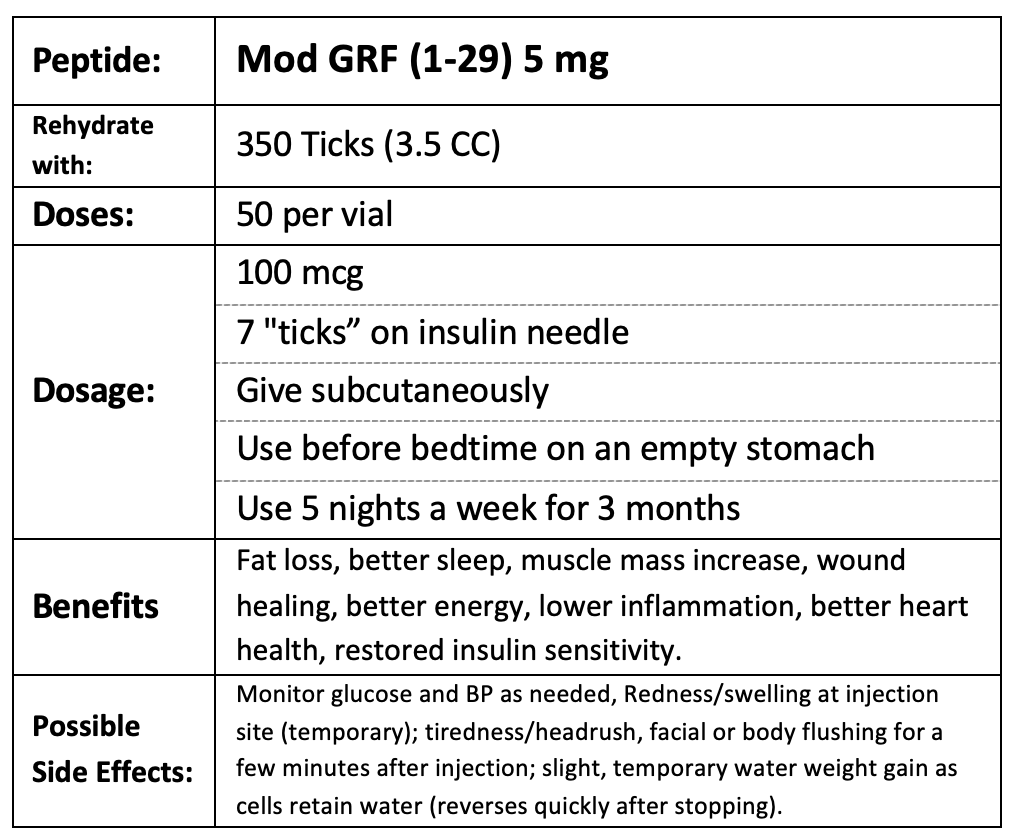
Note the different reconstitution volumes. 350 ticks for the standalone 5 mg vial, 250 for the 10 mg blend. Getting these the wrong way round changes your dose substantially, so check which vial you are holding.
Why before bedtime, empty stomach. Your largest natural growth hormone pulse happens during deep sleep, so bedtime dosing works with that rhythm. Food, particularly carbohydrate, blunts growth hormone release.
What is Mod GRF (1-29)?
A modified growth hormone releasing factor, sometimes called CJC-1295 without DAC. It acts on the GHRH receptor at the pituitary, prompting release of your own growth hormone rather than supplying hormone from outside.
That distinction matters for the same reason it does with ipamorelin: taking exogenous growth hormone shuts down your own production, while these peptides work within the existing feedback loop.
Why is it blended with ipamorelin?
Because they push the same outcome through two different receptors.
| Acts on | |
|---|---|
| Mod GRF (1-29) | Growth hormone releasing hormone receptor |
| Ipamorelin | Growth hormone secretagogue receptor |
Dawn's description of the result: front to back, two-way growth hormone stimulation. And her summary of why people use the blend rather than either alone:
Boss mode: these two peptides together, 1+1=4.
That is why the blend is the form most people end up on.
Reported benefits
Standalone Mod GRF:
- Fat loss
- Better sleep
- Muscle mass increase
- Wound healing
- Better energy
- Lower inflammation
- Better heart health
- Restored insulin sensitivity
The blend adds: increased energy, better sleep, muscle gain, fat loss, through the two-way stimulation described above.
Side effects
- Monitor glucose and blood pressure as needed
- Redness or swelling at the injection site, temporary
- Tiredness or head rush after injection
- Facial or body flushing for a few minutes after injection
- Slight, temporary water weight gain as cells retain water, which reverses quickly after stopping
"Monitor glucose and BP as needed" is on Dawn's own dosing table and is worth treating as instruction rather than boilerplate. Growth hormone affects glucose handling.
Raising IGF-1 matters for anyone with a cancer history, since IGF-1 promotes cell growth. Anyone diabetic or insulin resistant should involve their physician.
Do your own research.
Sourcing and quality
Peptides sold outside compounding pharmacies are labelled "Not For Human Consumption and For Research Use Only." Always ask for batch-specific third-party testing.
VIGEO Health does not sell injectable peptides. Email dawn@vigeohealth.net.
Competitive athletes: growth hormone releasing peptides are prohibited by WADA. Check the current list.
Test your foundations first
Growth hormone tells tissue to build, and building consumes zinc, magnesium and the cofactors that drive protein synthesis and bone formation.
Sleep is the other input. These peptides work with your natural sleep-linked growth hormone pulse, so they do considerably less for someone sleeping five broken hours a night. Fix the sleep and the peptide has something to work with.
See what the OligoScan measures
What this page does not tell you
- Mod GRF is not an approved medication. It is sold as a research compound outside pharmaceutical manufacturing standards.
- Long-term human data is limited.
- IGF-1 elevation is not neutral for anyone with a cancer history.
- Growth hormone affects glucose metabolism, hence the monitoring instruction.
- Not appropriate in pregnancy.
- Prohibited in tested sport.
Related
Questions and Answers
Q: How is Mod GRF (1-29) dosed? A: Standalone, 100 mcg which is 7 ticks on an insulin syringe, given subcutaneously before bedtime on an empty stomach, five nights a week for three months. A 5 mg vial reconstituted with 350 ticks gives 50 doses. As the ipamorelin blend, 100 to 200 mcg or 5 to 10 ticks, from a 10 mg vial reconstituted with 250 ticks.
Q: Why is Mod GRF blended with ipamorelin? A: Because they act on different receptors to reach the same outcome. Mod GRF acts on the growth hormone releasing hormone receptor while ipamorelin acts on the growth hormone secretagogue receptor, producing what is described as front to back, two-way growth hormone stimulation.
Q: What is Mod GRF (1-29)? A: A modified growth hormone releasing factor, sometimes called CJC-1295 without DAC. It acts on the GHRH receptor at the pituitary to prompt release of the body's own growth hormone, rather than supplying hormone from outside, so the natural feedback loop stays intact.