
Somewhere during COVID, zinc became everyone's favorite immune-system mineral.
Feel a cold coming on? Take zinc.
Want better immunity? Take zinc.
Read that zinc supports hundreds of enzymes? Well, surely a little more couldn't hurt.
Except minerals don't work that way.
While researching zinc for my OligoScan book, I became increasingly interested in something we rarely discuss when recommending supplements.
Every time you increase one mineral, you may be changing the balance of several others.
And zinc has a particularly interesting relationship with copper.
Why Morley Robbins tells people to stop taking zinc
If you've followed Morley Robbins and his Root Cause Protocol, you know he has a rather unpopular recommendation:
Stop taking supplemental zinc.
Not because zinc isn't important. It's essential to hundreds of enzymes and numerous biological processes.
His concern is what happens when we keep adding zinc without considering copper.
Zinc and copper compete during intestinal absorption. When zinc intake increases substantially, it stimulates the production of a protein called metallothionein in intestinal cells.
Metallothionein binds copper strongly, trapping some of it inside those cells until they're naturally shed.
The result? Less copper gets absorbed.
Think about that.
The mineral everyone started taking to support their immune system can actually interfere with the absorption of another essential mineral.
And that other mineral does some pretty important things.
Why does copper matter so much?
Copper doesn't get nearly the attention zinc does.
But copper is involved in mitochondrial energy production, connective tissue formation, antioxidant defense, and iron metabolism.
That last one is particularly interesting.
The copper-dependent protein ceruloplasmin helps convert iron into a form that can be transported by transferrin.
So when someone has an iron problem, I don't automatically assume iron is the only mineral worth investigating.
What if the body has plenty of iron but isn't handling it properly because copper metabolism is disrupted?
Sometimes the mineral that appears to be the problem isn't the mineral that started it.
And when we repeatedly supplement zinc without considering copper, we may be complicating the very processes we're trying to improve.
How much zinc are you actually taking?
Here's where things get sneaky.
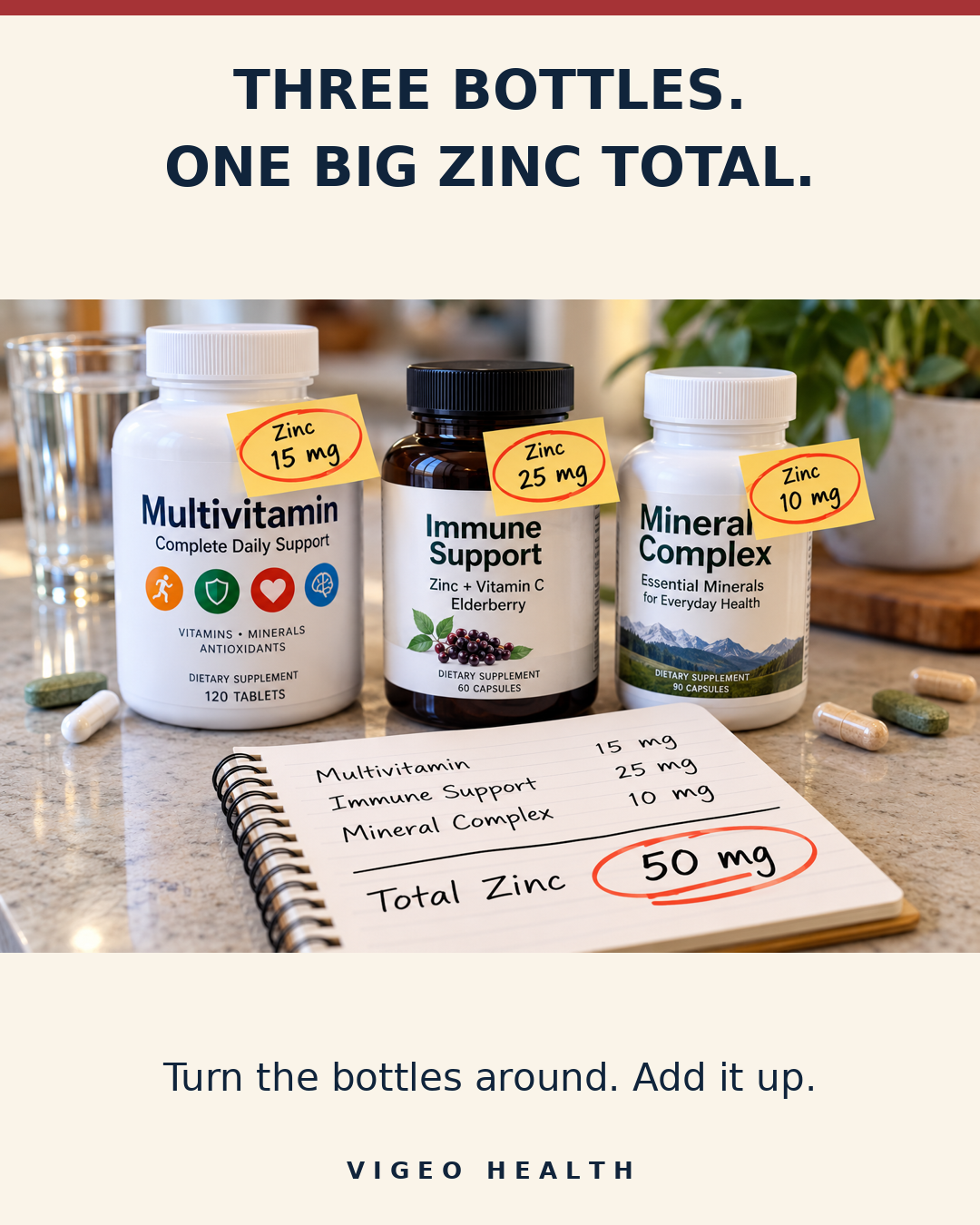
Let's say you're taking:
A multivitamin containing 15 mg of zinc.
An immune-support supplement containing another 25 mg.
A mineral formula with another 10 mg.
That's 50 mg of supplemental zinc before you've eaten breakfast.
And we haven't even counted your food.
Most people aren't adding these numbers together because they're taking three different products for three different reasons.
The label on each bottle looks perfectly reasonable.
It's the combined total that tells the story.
For perspective, the recommended dietary allowance for zinc is 8 mg daily for adult women and 11 mg for adult men. The established upper limit for adults is 40 mg daily from all sources.
Our hypothetical supplement routine has already passed that.
And zinc isn't the only nutrient that gets duplicated across multiple supplements.
This is one reason I encourage clients to bring me a complete list of everything they're taking, not just the supplements they consider important.
Sometimes the most useful supplement recommendation is figuring out what to stop taking.
What does an OligoScan tell us about zinc and copper?
This is where things get particularly interesting.
When I examine zinc and copper on an OligoScan, I'm not treating those readings as absolute measurements of how much of either mineral is stored in the body.
The OligoScan measures peripheral tissue, and my interpretation focuses heavily on patterns of mineral mobilization.
High doesn't always mean too much. Low doesn't always mean not enough.
That's why I look at mineral relationships, trends, and the broader picture rather than simply recommending more of whatever appears low on a report.
And it's why I don't automatically recommend zinc just because an OligoScan shows a low zinc reading.
Why I've changed my mind about Zinc
I used to think of zinc primarily as an essential mineral people needed to get enough of.
Now I'm much more concerned about how much supplemental zinc people are taking without realizing it.
I've come to agree with Morley Robbins that most people should stop routinely supplementing zinc.
Zinc is essential. Supplemental zinc is a different conversation.
And before reaching for another immune-support supplement, I'd encourage you to look at what's already in your cabinet.
Turn those bottles around. Read the labels. Add up the zinc.
You might discover you're taking considerably more than you thought.
The question isn't how much zinc you can add.
It's whether you needed to add any in the first place.