
“I’m getting older.”
Fair enough. So is everybody else. But what usually follows that sentence deserves a little inspection.
I can’t get stronger. I’m too old to learn that. Of course I’m tired. That’s just what happens.
Somewhere along the way, a birthday can become an explanation for everything. Age gets blamed like the dog standing beside an overturned trash can—sometimes correctly, sometimes because it’s conveniently available.
Before you accept a limitation, ask whether you’ve actually tested it.
A belief can quietly become a decision
Suppose you believe balance inevitably disappears with age. You might avoid uneven trails. Then you get less practice navigating uneven ground. Your confidence shrinks, and eventually the trail really does feel intimidating.
Now the belief seems confirmed.
That doesn’t mean every physical limitation begins in the mind. Injuries, illness, and biological changes are real. But expectations can influence what we attempt, how we respond to setbacks, and whether we seek help.
Researchers have examined this connection. In a study following older adults, more positive age stereotypes were associated with a greater likelihood of recovering from disability. Because it was observational research, it cannot prove that changing a belief caused recovery. It does suggest that our assumptions about aging deserve attention alongside physical health. [1]
That is a more interesting conversation than “think young.”
Nobody needs homework involving pretending their knees are twenty.
Whose voice is making the rules?
Listen to the phrases you use when something becomes difficult.
People my age don’t do that.
My mother had this problem, so I will too.
It’s too late to start.
Where did those rules come from? A doctor describing a specific condition? A family member? An advertisement featuring someone over sixty staring wistfully out a window?
There is a difference between useful information and a prediction you’ve started living inside.
This is one reason VIGEO includes belief work in its broader approach. Belief Code is an energy-work modality that explores proposed subconscious belief systems. Its framework is distinct from research on aging expectations; those studies do not establish that Belief Code changes physical health outcomes. But the question it invites is useful: What have you accepted as true about yourself? [2]
You can begin exploring that question simply by noticing your own language.
Replace the verdict with a question
“I’m too old to get stronger” is a verdict.
“What would help me get stronger from where I am now?” opens a door.
“I’m just tired because I’m aging” closes the investigation.
“What might be contributing to this fatigue?” gives you something to work with.
That could lead to a review of sleep, food intake, medications, training, or an appropriate health assessment. Where relevant, VIGEO may also explore mineral and nutrient patterns through an OligoScan consultation. The purpose is to ask better questions in context, rather than let either your birth date or a single test result explain your entire life.
Curiosity leaves room for options.
Give yourself a small experiment
Choose one activity you miss—or one you’ve been quietly curious about.
Maybe you want to hike farther, learn piano, carry your own suitcase, or get up from the floor without planning the operation in advance.
Pick a starting point that suits your current ability. Practice. Track something concrete: repetitions, distance, confidence, or how much assistance you need. Adjust when necessary.
You’re gathering evidence about what is possible for you now.
Some things will require adaptation. Some will require professional guidance. Some may surprise you. Learning that you can improve—even modestly—can be much more persuasive than a motivational quote pasted over a sunset.
And if progress stalls, investigate. You haven’t failed a positive-thinking exam. You’ve found another question.
Aging deserves honesty. It also deserves curiosity, support, and a little less obedience to gloomy predictions.
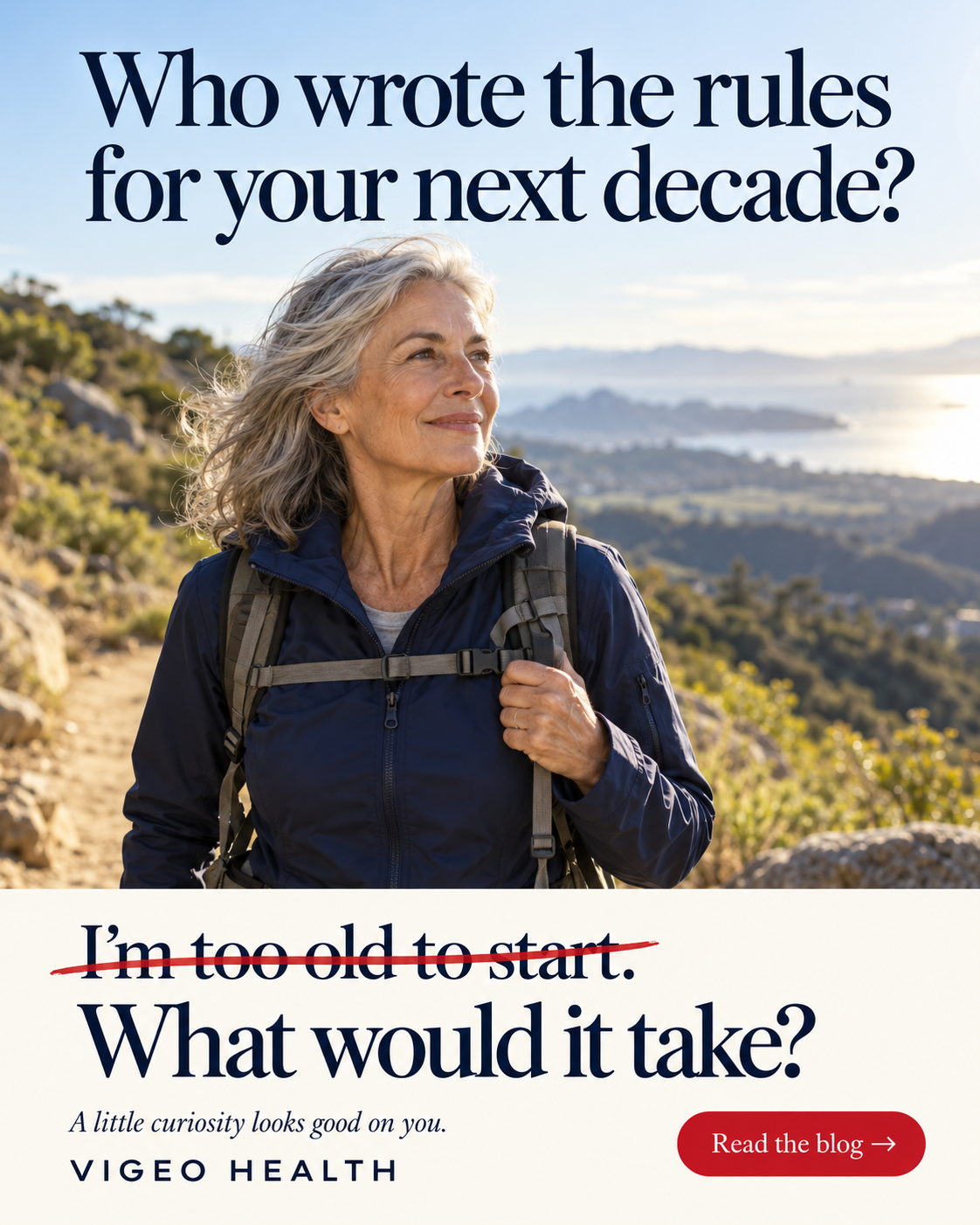
Before you say “I’m too old,” try asking “What would it take?”
Explore VIGEO’s individualized approach if you want help examining both the physical patterns and the beliefs shaping your next steps.
Sources
- Levy et al. Association between positive age stereotypes and recovery from disability in older persons. https://pmc.ncbi.nlm.nih.gov/articles/PMC3614078/
- Discover Healing. The Belief Code. https://discoverhealing.com/the-belief-code