
The deeper I get into researching and writing my OligoScan book, the more I realize how many things I've changed my mind about over the years.
Calcium is a big one.
For decades, we've been told to drink milk, take calcium supplements, and make sure we're getting enough calcium to prevent osteoporosis.
The message was simple: More calcium equals stronger bones.
But what if the bigger question isn't how much calcium we're getting?
What if it's where that calcium ends up?
The Calcium Lie
Years ago, I encountered a book called The Calcium Lie by Dr. Robert Thompson and Kathleen Barnes.
The premise caught my attention: Bones aren't made of calcium alone. They're a complex structure containing multiple minerals.
And calcium doesn't work independently. Its metabolism involves magnesium, phosphorus, vitamin D, vitamin K, boron, and several hormones.
Suddenly, the idea that we could solve osteoporosis simply by swallowing more calcium seemed a little simplistic.
Calcium needs a conductor
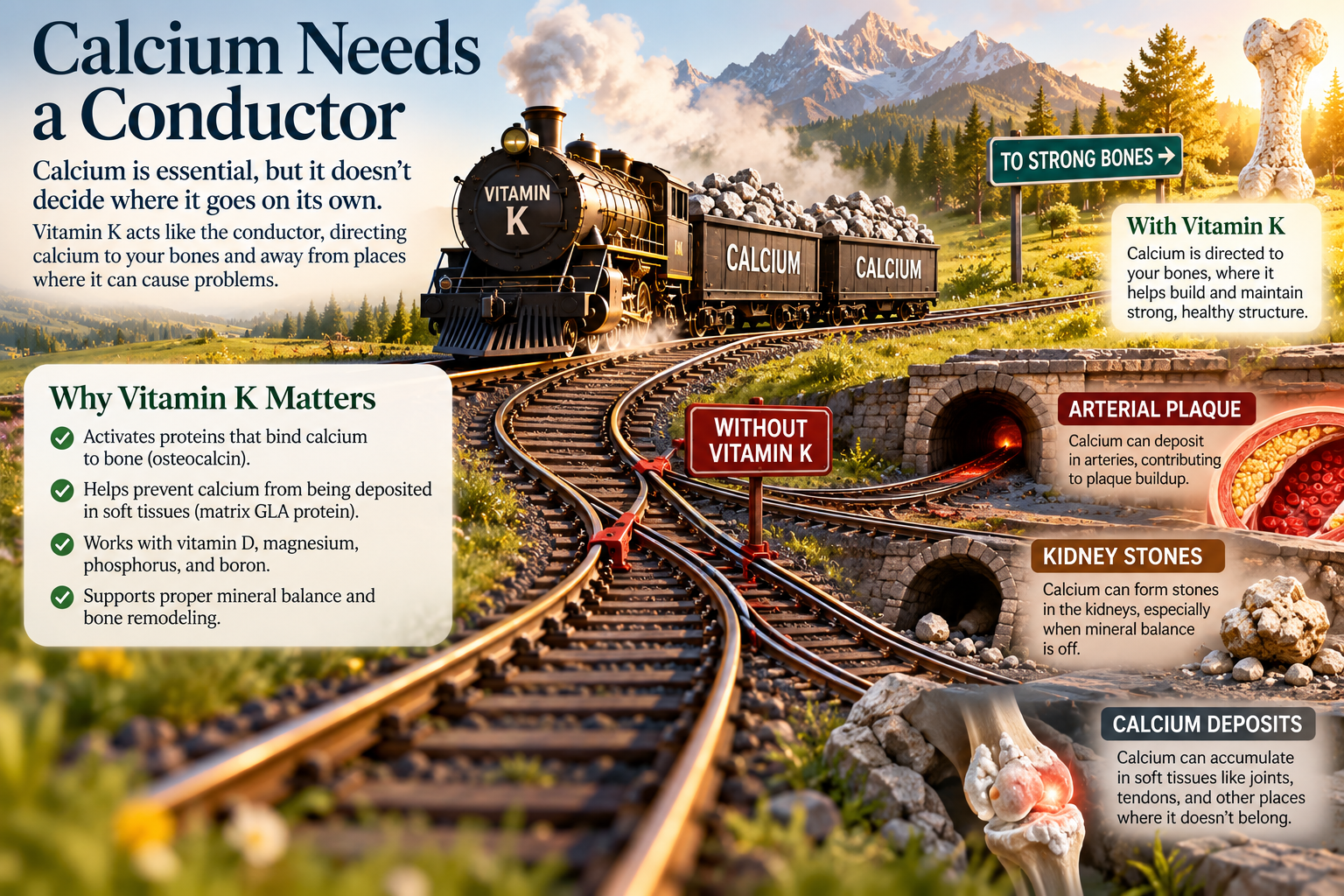
Imagine calcium as coal being transported in railroad cars.
The coal is valuable. We need it. But delivering it to the wrong destination isn't particularly helpful.
Now imagine vitamin K as the train conductor, helping direct that cargo where it belongs.
Vitamin K activates a protein called osteocalcin, which participates in binding calcium within bone.
It also activates another protein called matrix Gla protein (MGP), which helps inhibit calcium deposits in soft tissues, including blood vessel walls.
Two different proteins. Two important jobs.
One helps support calcium's incorporation into bone. The other helps prevent unwanted calcification.
That's pretty remarkable for a vitamin most people associate only with blood clotting!
What happens when calcium ends up in the wrong places?
Calcium is essential for healthy bones and teeth.
But calcium deposits can also develop where we don't particularly want them.
- Arteries: Calcium can accumulate within atherosclerotic plaques and contribute to arterial stiffness.
- Kidneys: Calcium combines with substances such as oxalate or phosphate to form many common kidney stones.
- Soft tissues: Calcium deposits can develop in tendons, joints, and other tissues.
These conditions have different causes, and vitamin K isn't the sole explanation for any of them.
But vitamin K–dependent proteins are part of the body's system for regulating calcification, particularly in bones and blood vessels.
That raises an interesting question:
Are we paying enough attention to the nutrients that help regulate calcium, rather than simply adding more of it?
And don't forget boron
Boron is another mineral that rarely gets invited into the bone-health conversation.
Research suggests boron influences calcium, magnesium, and vitamin D metabolism, although its precise role in human bone health is still being investigated.
Magnesium also participates in bone metabolism, while vitamin D regulates calcium absorption and blood calcium balance.
And physical activity—especially resistance training—stimulates bone remodeling.
Apparently, calcium has an entire crew working behind the scenes.
What I've changed my mind about
When I began studying mineral relationships through OligoScan, I became much more interested in calcium balance than calcium alone.
Too little calcium can contribute to bone problems. But taking more doesn't automatically guarantee stronger bones.
And a normal blood calcium level doesn't tell us whether our bones are strong or whether calcium deposits are developing elsewhere.
That's what I appreciate about The Calcium Lie. It challenges the idea that one mineral can solve a complicated biological problem.
Calcium is important. But knowing where the train is headed matters just as much as loading more coal into the cars.
And that's a much more interesting conversation than simply asking how many glasses of milk you've had today.
Want to explore further?
Read an excerpt from The Calcium Lie II by Robert Thompson and Kathleen Barnes.