
Somewhere along the way, adults were assigned very sensible exercise. Walk briskly. Count your steps. Lift the heavy things, then put them back exactly where you found them.
Climbing over something? At your age?
Apparently, playgrounds have an expiration date.
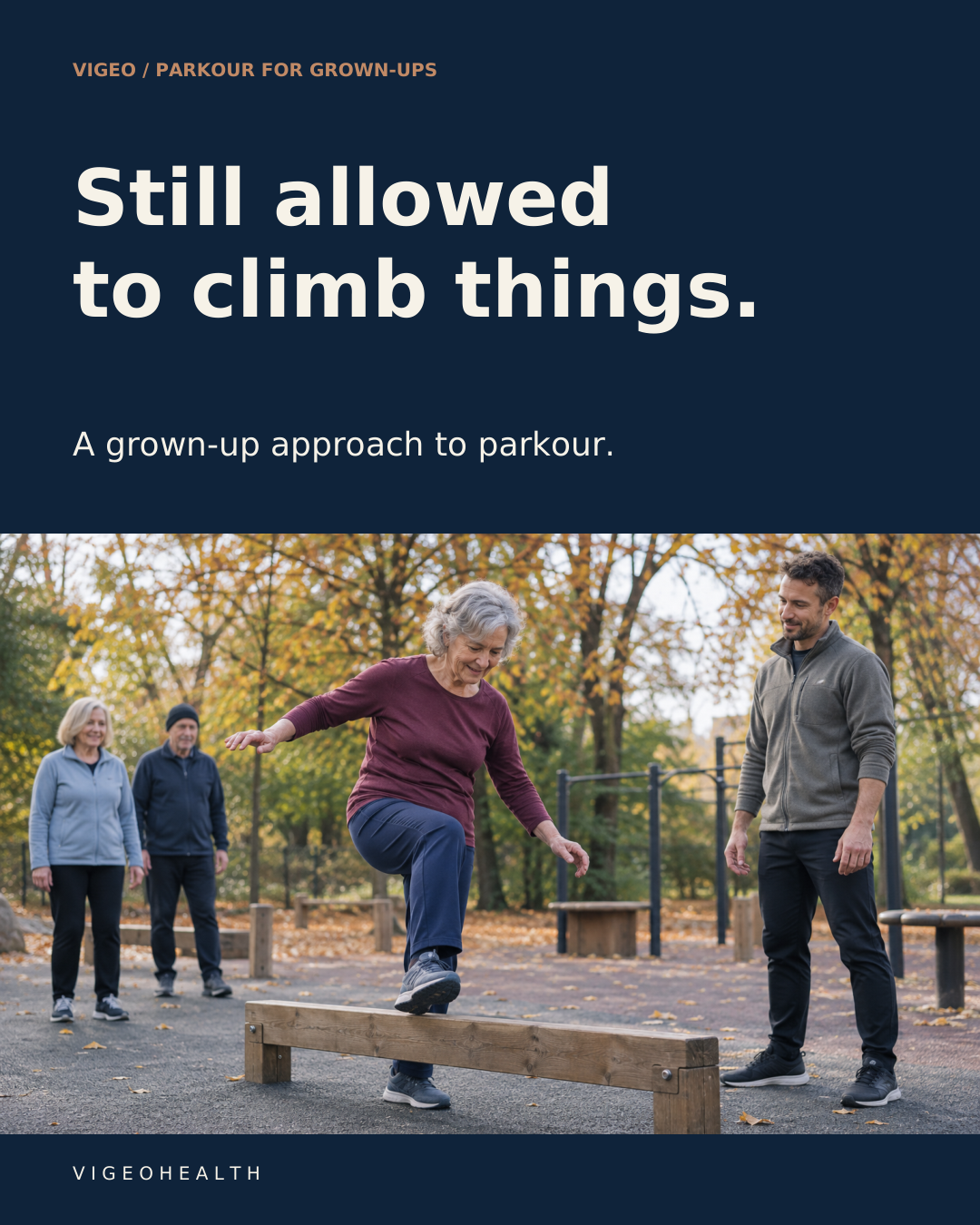
Parkour challenges that idea. And parkour for older adults can begin with low, manageable obstacles, coached balance work, and learning different ways to move through a space.
Your first session does not require jumping off a rooftop, or a film crew.
You've already met the obstacle course
Parkour treats the environment as a movement puzzle. Practitioners learn smaller skills, then connect them. Planning and control are part of the discipline. [1]
Where should the foot go? Would a hand help? Can the obstacle be stepped over, moved around, or approached differently?
Most of us already encounter an unofficial version: the log across a trail, the awkward garden fence, the camping chair positioned directly between us and the snacks.
The stopwatch can sit this one out.
Start smaller than your imagination
An adapted session might include stepping over a low obstacle, moving underneath something, placing a foot precisely, or changing position with control.
A coach might start with a line on the floor before introducing an elevated surface. A movement can be separated into a step, a pause, and a controlled return. These are examples of adapting a task, rather than a workout everyone should copy.
The point is to build more movement options. Walk, step, reach, turn, climb when appropriate. Give the body a few verbs beyond “sit” and “scroll.”
There is no requirement to impress a teenager. An excellent feature of the sport, frankly.
Yes, somebody studied this
In a small 2025 study, 20 adults averaging about 68 completed ten weeks of modified parkour, including coached obstacle work, balance exercises, and falling techniques. [2]
Participants improved on a functional-reach test. Other mobility tests did not improve significantly, and there was no comparison group. The study cannot establish that parkour prevents falls or works better than another exercise program. [2]
An interesting beginning. Nobody earned a prescription for jumping off the garage.
Programs designed for older adults already exist, including PK Move's PK Silver. A beginner class can be built around the people attending it. [4]
Bring curiosity. Bring a friend.
Look for an experienced coach who adapts challenges to your current ability. Ask how beginners learn control and progress. Wear shoes with reliable grip, warm up, and leave falling techniques, jumping, and elevated skills to qualified instruction. [5]
A friend can make the first class more inviting. Choose one who understands encouragement. “I bet you can't” is a terrible training plan.
If you have osteoporosis, recent fractures, dizziness, or a history of falls, get individualized advice before adding impact or balance challenges.
At VIGEO, the question is what you want your health to let you keep doing. The trail, the garden, the camping trip, the unexpected adventure: those are useful reasons to practice moving in more ways.
Getting older does not automatically revoke your playground privileges.
Start low. Learn control. You're still allowed to play.