

How is GHK-Cu dosed?
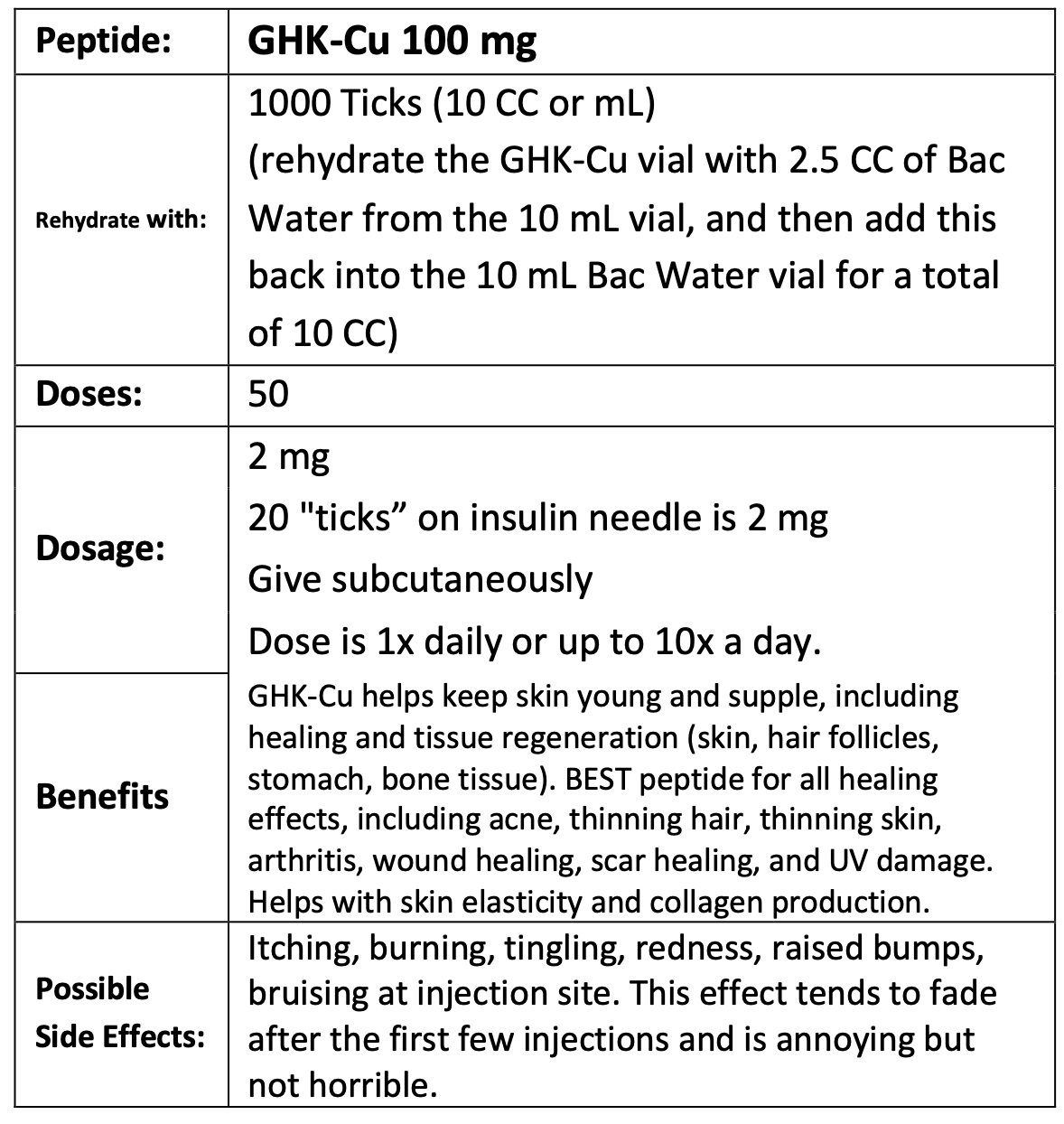
Optional intensive approach. Hourly, up to 10 times a day, for several days. Given the one-hour half-life, that is the practical equivalent of delivering 100 to 200 mg at once. If you have access to an insulin pump, 0.5 mg per hour for 20 hours a day achieves the same thing.
Topical. Derma roller plus a skin crème containing GHK-Cu and methylene blue. Topical is not as powerful as injection. Consider pairing with DMSO to drive it deeper into the skin.
What is GHK-Cu?
A naturally occurring copper complex found in human plasma, saliva and urine. Your body already makes it, and levels decline with age.
It acts as an anti-inflammatory agent controlling oxidative damage after tissue injury, and it signals tissue remodelling and the generation of new, healthy tissue.
The mechanism that sets it apart: it binds to DNA and turns genes on and off. It has an impact on thousands upon thousands of genes, which makes it a powerful regulator rather than a compound with one narrow action.
That breadth is why it is almost considered a peptide Bio-Regulator, which is high praise from people who study peptides. One peptide guru called it the SHAM-WOW of peptides, for anyone old enough to remember the commercial.
What is it studied for?
Skin
- Tightens loose skin
- Reverses thinning of skin
- Improves firmness and elasticity
- Increases collagen levels by up to 70%
- Reduces fine lines and wrinkles by 35%
- Reduces photodamage and hyperpigmentation
- Reduces skin spots and lesions
- Protects from UV damage
- Stimulates collagen and glycosaminoglycan in skin fibroblasts
Healing and repair
- Probably the best peptide for all healing effects
- Heals old scars
- Wound healing
- Promotes tissue regeneration in skin, hair follicles, stomach and bone tissue
- Promotes blood vessel growth
Other
- Hair growth, preventing and correcting hair loss
- Helps with arthritis
- Helps with pulmonary fibrosis
- Liver function
- Anti-inflammatory, reducing pain
- Heals nerves and reduces certain types of nerve pain
- Antioxidant effects
- Anti-cancer, specifically colon cancer
On that last entry. It comes from gene expression research showing GHK-Cu resets gene activity associated with several cancers, colon cancer among them. That is genuine and interesting laboratory work. It is not a treatment claim, and nobody with a cancer diagnosis should be substituting this for oncology care. Read it as a reason the gene-regulation mechanism is being studied seriously.
Side effects
Great safety profile.
At the injection site you may see itching, burning, tingling, redness, raised bumps, or bruising. This is due to the copper part of the peptide, which is also what makes the liquid in the vial a brilliant blue. The effect tends to fade after the first few injections. Annoying, not horrible.
One thing worth knowing about the copper. GHK-Cu delivers copper, and copper status matters throughout Dawn's work. Selenium recycling depends on it, and zinc and copper compete. Anyone already supplementing copper, or anyone with Wilson's disease, should factor that in rather than treat GHK-Cu as copper-neutral.
Do your own research.
Sourcing and quality
Peptides sold outside compounding pharmacies are labelled "Not For Human Consumption and For Research Use Only." Always ask for batch-specific third-party testing. If it is not available, go elsewhere.
VIGEO Health does not sell injectable peptides. Third-party vendors can be recommended on request: email dawn@vigeohealth.net.
Test your foundations first
GHK-Cu signals collagen production. Collagen synthesis requires vitamin C, zinc, and copper as cofactors. Signalling for collagen without the raw materials is the clearest example on this site of why foundations come first: the instruction arrives, the building blocks are missing, and the result disappoints.
There is a second reason to test here specifically. GHK-Cu delivers copper, and copper sits in a relationship with zinc and selenium. Knowing where you already stand before adding more is straightforwardly sensible.
See what the OligoScan measures
What this page does not tell you
- GHK-Cu is not an approved medication. It is sold as a research compound outside pharmaceutical manufacturing standards.
- The 70% collagen and 35% wrinkle figures come from specific studies under specific conditions. Individual results vary considerably.
- The gene expression work is laboratory research. Affecting thousands of genes is a description of mechanism, not a demonstrated clinical outcome.
- The anti-cancer entry is not a treatment claim.
- Anyone with Wilson's disease or copper overload should not use this without medical supervision.
- Pulmonary fibrosis and arthritis need proper medical management.
- The intensive hourly protocol should not be self-directed.
References and further reading
- Regenerative and Protective Actions of the GHK-Cu Peptide in the Light of the New Gene Data, International Journal of Molecular Sciences
- Literature on GHK-Cu, collagen synthesis and glycosaminoglycan stimulation in skin fibroblasts.
- VIGEO Health Medical Disclaimer
Related peptides
- BPC-157 — the other broad healing peptide
- Minerals and micronutrients — the collagen cofactors
- All peptides
Questions and Answers
Q: How is GHK-Cu dosed? A: Once daily for several months up to a year, with vials containing up to 100 doses. Because the half-life is only one hour, an intensive option exists of hourly dosing up to ten times a day for several days, or 0.5 mg per hour for 20 hours via insulin pump. Topical application via derma roller is possible but less powerful than injection.
Q: What is GHK-Cu? A: A naturally occurring copper complex found in human plasma, saliva and urine, which the body produces and whose levels decline with age. It acts as an anti-inflammatory controlling oxidative damage after tissue injury, and signals tissue remodelling and the generation of new tissue.
Q: How does GHK-Cu work? A: It binds to DNA and switches genes on and off, affecting thousands of genes. That breadth of gene regulation is why its reported effects span skin, hair, wound healing, nerves, liver and bone rather than acting on a single pathway, and why it is described as almost a peptide bio-regulator.
Q: Does GHK-Cu work topically or does it need injecting? A: Both work, but topical application is not as powerful as injection. Topical use is typically via derma roller with a skin crème containing GHK-Cu, sometimes paired with DMSO to drive it deeper into the skin.