
STATUS: APPROVED BY DAWN, OCTOBER 16, 2026 Audience: Athlete / Performance By Dawn Westrum | Intended publication week: October 19, 2026 Body words: 783
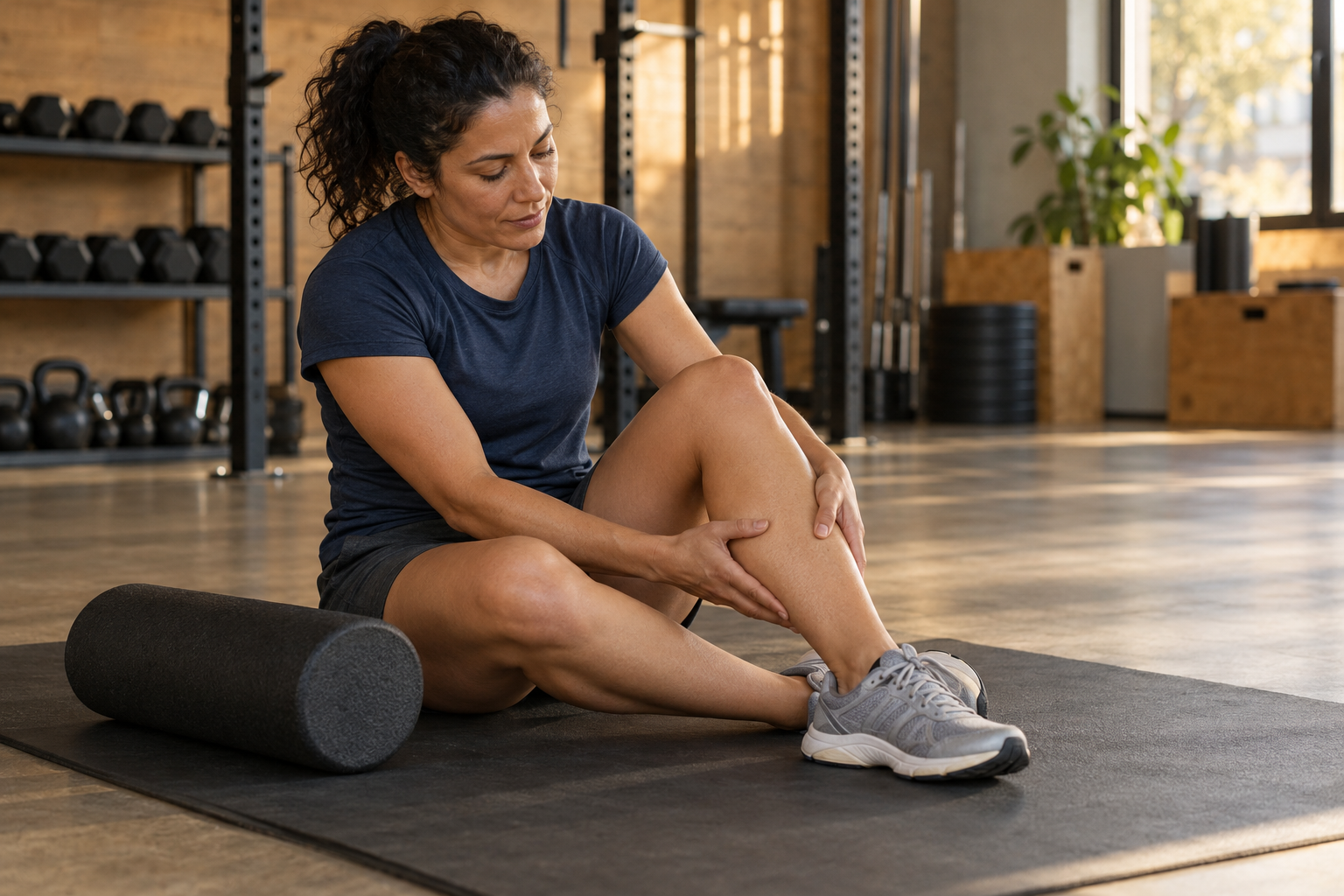
You bought the roller. Then the firmer roller. Then the little ball that looks innocent until you put your hip on it.
Somewhere along the way, recovery started resembling a disagreement with the floor.
Can foam rolling help athletes move more freely? Yes, it can improve short-term range of motion. But feeling looser does not prove you broke up scar tissue or permanently remodeled your fascia. The interesting question is what changed, and whether that change helps you train. 1,2
Fascia is real. The explanation still matters.
Fascia is connective tissue that surrounds and supports structures throughout the body. It is part of how our tissues are organized and move together. It deserves more respect than being treated as packing material. 3
It also deserves better than becoming the explanation for every tight calf, sore hip, or disappointing Tuesday.
When a runner says, “My fascia is stuck,” that might describe how movement feels. It does not identify which tissue is responsible, whether there is an adhesion, or why the discomfort keeps returning. A sensation is a clue. It is not an ultrasound report.
That distinction matters because the explanation influences the response. If you believe something is glued down, harder pressure can seem like the obvious solution. If the problem involves sensitivity, loading, or movement tolerance, the useful next step may look different.
More movement does not always mean softer tissue
In a 2021 study, 45 healthy young adults were assigned to different durations of calf rolling. The 90-second and five-minute groups improved ankle range of motion shortly afterward. The researchers found no significant change in the measured calf-muscle stiffness or strength. By 30 minutes, the range-of-motion improvement had returned to baseline. 1
These were sedentary young adults, so this is not a race-performance trial. It does illustrate something useful: moving farther and changing measured tissue stiffness are separate outcomes.
Another small experiment adds a wrinkle. After 15 healthy participants received roller massage on one calf, ankle range of motion increased on both the treated and untreated sides. Measured muscle stiffness did not significantly change. The authors interpreted the pattern as consistent with altered sensory responses, including stretch tolerance. 2
The other leg apparently did not need its own appointment.
That finding does not settle every mechanism. It does make “I crushed the knot out” an incomplete explanation.
Relief is useful. It is not a tissue diagnosis.
None of this means rolling is pointless. If a short session makes your warm-up feel better, that is useful information. You do not need a dramatic structural story to justify a modest benefit.
Research is not uniform, either. A separate crossover trial involving 20 healthy volunteers found small reductions in measured thigh-tissue stiffness after rolling, although the changes did not exceed the study's threshold for confidently separating change from measurement variability. Different body regions, techniques, and measurement methods can produce different findings. 4
So avoid both extremes: “rolling permanently fixes fascia” and “rolling cannot affect tissue.” The evidence supports a more interesting conversation about which changes occur, under which conditions, and for how long.
For an athlete, the practical goal is usable movement. A few extra degrees during an assessment are one outcome. Running comfortably tomorrow is another. Ask which one you are actually trying to improve.
What if the tension has more than one contributor?
This is where the question connects with my work at VIGEO. Alongside physical recovery, I use Emotion Code and Body Code to explore emotional patterns that may be part of someone's experience of tension or discomfort. That is a complementary approach, not evidence that a session physically releases fascia. 5
If the roller gives you temporary relief but the same tension keeps returning, I am interested in the bigger picture: what was happening when it started, and what else might need attention?
Give the roller a job description
Choose one familiar movement before your next warm-up: a comfortable squat, ankle bend, or easy walking stride. Notice how it feels. Try a brief, tolerable rolling session, then repeat the same movement without forcing it. This is a personal observation, not a diagnostic test or a prescribed treatment dose.
Does movement feel easier? Does that benefit last into training? How do you feel later that day and the next morning? Compare that with a day when you simply warm up through movement. You are looking for a useful pattern, not trying to win an argument with your hamstring.
If the same spot demands daily rescue, widen the investigation. What changed in your mileage, terrain, strength work, footwear, or time spent sitting? A physical therapist or sports clinician can help assess persistent pain or lost function. Increasing pain is a reason to reassess the approach, not buy a sharper tool.
At VIGEO, understanding the pattern comes before adding another intervention. Keep the roller if it earns its place. Judge it by what it helps you do.
Explore VIGEO's athlete resources for a broader look at performance and recovery.
Sources
- Nakamura et al. (2021). The Acute and Prolonged Effects of Different Durations of Foam Rolling on Range of Motion, Muscle Stiffness, and Muscle Strength. Journal of Sports Science and Medicine 20:62–68. https://www.jssm.org/mobile/fulltextmobile.php?id=jssm-20-62.xml
- Nakamura et al. (2021). Local and Non-local Effects of Foam Rolling on Passive Soft Tissue Properties and Spinal Excitability. Frontiers in Physiology 12:702042. https://www.frontiersin.org/journals/physiology/articles/10.3389/fphys.2021.702042/full
- Cleveland Clinic. Fascia. Anatomy and clinical education; reviewed June 14, 2022. https://my.clevelandclinic.org/health/body/23251-fascia
- Schroeder, Wilke & Hollander (2021). Effects of Foam Rolling Duration on Tissue Stiffness and Perfusion: A Randomized Cross-Over Trial. Journal of Sports Science and Medicine 20:626–634. https://www.jssm.org/jssm-20-626.xml%3EFulltext
- VIGEO Health. Emotion Code, Body Code & Belief Code. Source for Dawn's practice approach, not clinical proof of fascia release. https://www.vigeohealth.net/therapies/emotion-code