

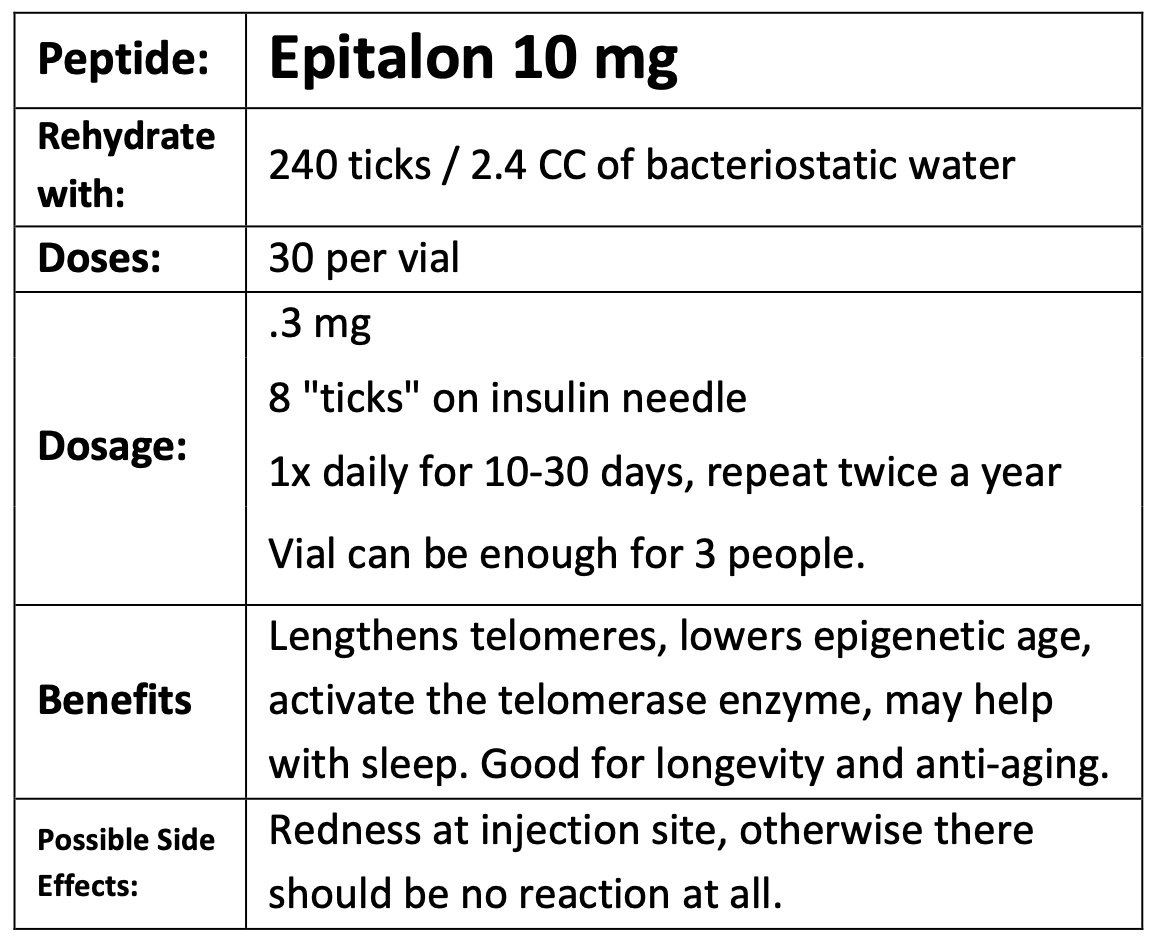
This is a cycled compound, not a daily one. Two short courses a year, not continuous use. That is unusual in this library and worth noticing.
New to injecting? The reconstitution and injection guide covers the step-by-step.
What is Epitalon?
Commonly called the primary anti-ageing peptide. It is one of the very few synthesised compounds shown to directly activate the telomerase enzyme in humans.
Telomerase renews and elongates telomeres, the caps on the ends of chromosomes that protect DNA from damage and from cancer-causing errors. Telomeres shorten with each cell division, and that shortening is one of the better-characterised markers of biological ageing.
By activating telomerase, Epitalon reduces telomere shortening, which is the basis for the claim that it can help you age backwards.
Reported benefits
- May be the ultimate anti-ageing peptide
- Increases telomere length and decreases mortality
- Stimulates healthy pineal gland synthesis of serotonin and melatonin
- Slows ageing of the reproductive system
- Increases conversion of T4 to T3 thyroid hormone
- Improves glucose tolerance
- Decreases insulin and triglyceride levels
- Increases longevity
- Decreases mortality and cancer
- Improves hypothalamic-pituitary dysfunction seen with disease and ageing
- Increases mean and maximal lifespan in animals
- Immune support, improving natural killer cell and T-helper cell function
After three years of Epitalon and other bio-regulator peptide therapy, human studies showed a 22-year decrease in telomere age.
Dawn's honest cons, and they are the best part of this post
Most peptide content lists benefits and stops. Hers does not.
No visible results. Nothing you can feel or see. That is a genuine problem with an anti-ageing compound: there is no feedback loop telling you whether it is doing anything.
Testing is expensive and mostly not worth it. Telomere testing runs around $500, and changes happen over years, so for most people the cost does not justify the information.
No need to use this if you are under 40. Telomere shortening is not yet the limiting factor at that age.
That combination, no visible result, impractical testing, age threshold, is a more useful summary than any benefits list.
Side effects
No real side effects. May improve sleep. May cause temporary facial flushing; if so, use kidney supplements or an antihistamine.
One addition worth having. Telomerase activation is the mechanism behind both the anti-ageing claim and the main theoretical concern: telomerase is also active in most cancer cells, which is part of how they divide indefinitely. Dawn's own list notes decreased cancer, and the research genuinely points both directions depending on context.
What that means practically: anyone with an active cancer or a cancer history should discuss this with their oncologist rather than deciding from an article. This is not a reason to avoid it. It is a reason it belongs in a supervised conversation.
Do your own research.
Where to learn more
Bill Lawrence has lowered his telomere age from the 70s to about 40. At a real age of 76, he and his wife are still ballroom dancing and very active. His human studies are now being published.
Listen to his podcast with Nathalie Niddam: Bio-regulator peptides, telomeres, and turning back the clock
Sourcing and quality
Peptides sold outside compounding pharmacies are labelled "Not For Human Consumption and For Research Use Only." Always ask for batch-specific third-party testing.
VIGEO Health does not sell injectable peptides. Email dawn@vigeohealth.net.
What this page does not tell you
- Epitalon is not an approved medication. Most published work originates from a single Russian research programme, which is a narrower evidence base than the claims suggest.
- "22-year decrease in telomere age" comes from that programme, in combination with other bio-regulators, not from Epitalon alone.
- Telomere length is a marker, not the whole of ageing. Changing a marker is not the same as changing an outcome.
- The telomerase and cancer relationship is genuinely unresolved.
- Long-term safety data does not exist.
Related
- Thymosin Alpha 1 — the other bio-regulator in the library
- All peptides
Questions and Answers
Q: How is Epitalon dosed? A: Daily for 10 to 30 days, taken in the morning, repeated twice a year. It is a cycled compound rather than a continuous one, so two short courses a year rather than ongoing daily use.
Q: What does Epitalon do? A: It is one of very few synthesised compounds shown to directly activate telomerase in humans. Telomerase renews and elongates telomeres, the protective caps on the ends of chromosomes, so activating it reduces the telomere shortening associated with ageing.
Q: Should you use Epitalon under age 40? A: No. Telomere shortening is not the limiting factor at that age, and there is no need for it. It is also worth knowing that Epitalon produces no visible or felt results, and telomere testing costs around $500 with changes occurring over years, so most people cannot verify whether it is working.