

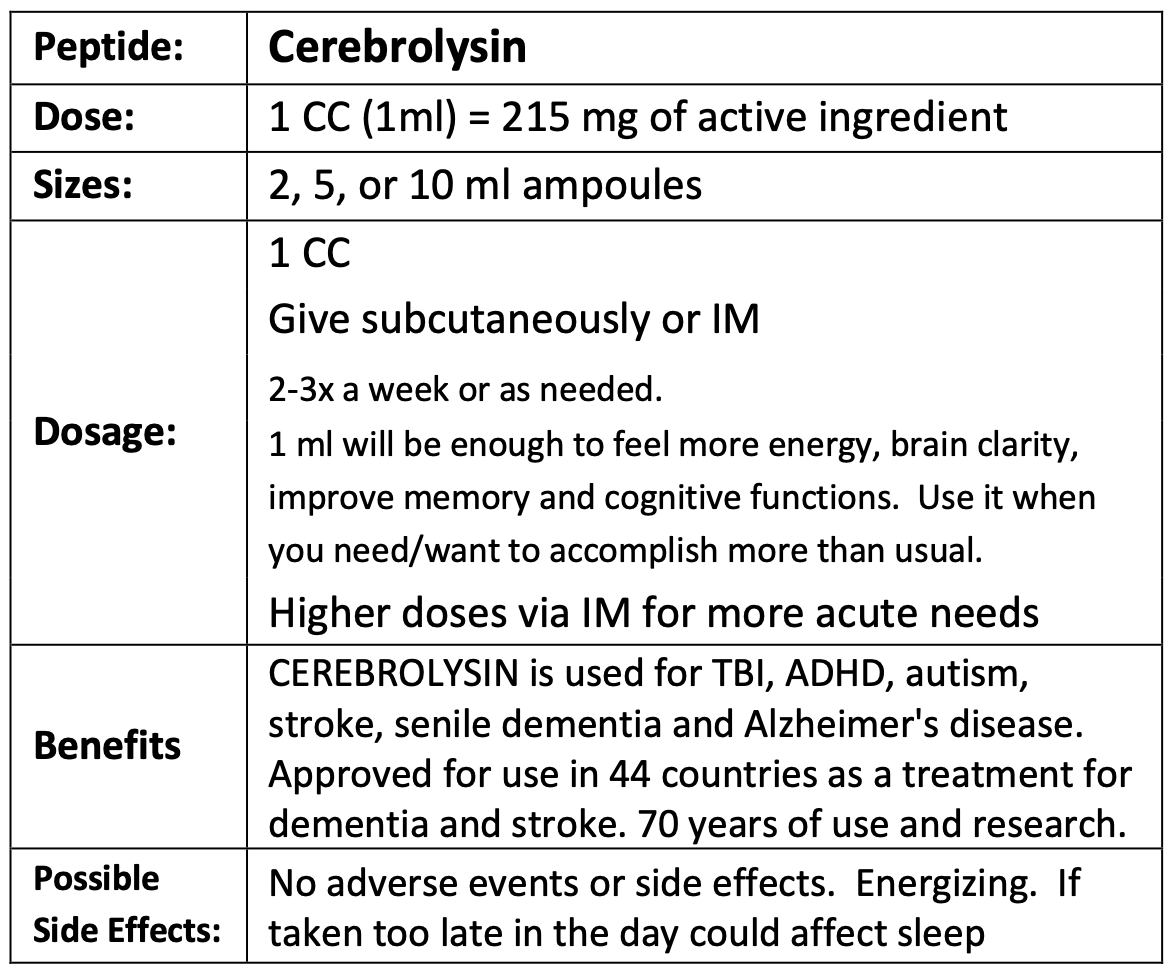
Cerebrolysin comes in ampoules, not lyophilised vials, so it does not need reconstituting. It has its own handling requirements and its own how-to guide, separate from the standard peptide directions. See the peptides page.
What is Cerebrolysin?
A neuropeptide preparation consisting of low-molecular-weight peptides and amino acids, produced from purified brain proteins. It is designed to mimic the action of endogenous neurotrophic factors, the signalling molecules that support neuron survival, growth and repair.
It has roughly 70 years of use and research behind it, and is approved in 44 countries as a treatment for dementia and stroke. That places it in a different category from most compounds in this library: it is an established medicine in much of the world, rather than an investigational one.
It is not approved in the United States.
What is it used for?
- Traumatic brain injury (TBI)
- Stroke
- Senile dementia and Alzheimer's disease
- ADHD
- Autism
Plus the everyday use Dawn describes: energy, brain clarity, memory and cognitive function.
On the ADHD and autism entries. These are contexts in which cerebrolysin has been studied and used, particularly in countries where it is approved. They are not established treatment claims, and neither condition should be managed with this in place of proper care. For a child in particular, this belongs with a paediatric specialist rather than as a self-directed decision.
Side effects
No adverse events or side effects. Energising, so if taken too late in the day it could affect sleep.
"No adverse events" reflects a strong safety record across decades of use, and it is close to accurate, but the product information in countries where it is approved does list possible reactions including injection site effects, dizziness, and rare allergic reactions. Worth knowing rather than being surprised.
And cerebrolysin is derived from porcine brain protein. That matters for anyone avoiding porcine-derived products for dietary or religious reasons, and it is not obvious from the name.
Do your own research.
Sourcing and quality
Cerebrolysin is a manufactured pharmaceutical in the countries where it is approved. Material obtained outside those channels is not that product, and given this is a biologically derived preparation rather than a synthesised peptide, source quality matters more here than usual.
VIGEO Health does not sell injectable peptides. Third-party vendors can be recommended on request: email dawn@vigeohealth.net.
Test your foundations first
Cognitive symptoms have causes worth ruling out before reaching for a neuropeptide: B12 deficiency, thyroid dysfunction, sleep apnoea, and mineral status all affect memory and clarity, and all are correctable.
Mercury in particular is worth knowing about here. It is neurotoxic, accumulates in nervous tissue, and produces exactly the word-finding and short-term memory picture people use cerebrolysin for. More on that here.
See what the OligoScan measures
What this page does not tell you
- Cerebrolysin is not approved in the United States, despite approval in 44 other countries.
- Trial results in Alzheimer's and stroke are mixed. Meta-analyses have found modest or uncertain benefit depending on the endpoint, which is worth knowing alongside the 70-year history.
- TBI, stroke and dementia require proper medical care. This is not a substitute.
- ADHD and autism in children belong with a specialist.
- Porcine-derived.
- Do not take it late in the day unless you want to be awake.
References and further reading
- Clinical literature on cerebrolysin in stroke, traumatic brain injury and vascular dementia.
- Product information from jurisdictions where cerebrolysin is approved.
- VIGEO Health Medical Disclaimer
Related
- Thymosin Alpha 1 — the other compound here with a substantial clinical history
- Hidden signs of mercury toxicity
- All peptides
Questions and Answers
Q: How is Cerebrolysin dosed? A: 1 CC, which is 1 ml containing 215 mg of active ingredient, given two to three times a week or as needed. It can be given subcutaneously or intramuscularly, with higher doses via IM for more acute needs. It comes in 2, 5 or 10 ml ampoules and does not require reconstituting.
Q: What is Cerebrolysin used for? A: Traumatic brain injury, stroke, senile dementia, Alzheimer's disease, ADHD and autism. It is approved in 44 countries as a treatment for dementia and stroke, with around 70 years of use and research behind it, though it is not approved in the United States.
Q: Does Cerebrolysin have side effects? A: The safety record across decades of use is strong, and it is often described as having no adverse events. It is energising, so taking it late in the day can affect sleep. Product information in countries where it is approved does list possible injection site reactions, dizziness, and rare allergic reactions.