
STATUS: APPROVED BY DAWN, OCTOBER 16, 2026 Audience: Active & Aging Adults By Dawn Westrum | Intended publication week: October 19, 2026 Body words: 796
You take a blood thinner. Fish oil joins the lineup for heart health. Turmeric arrives for your knees. A friend recommends a circulation blend. Meanwhile, breakfast includes a couple of kiwis.
Different reasons. Some overlapping effects. And suddenly, “What do you take?” needs a longer answer.
Some supplements can increase bleeding risk when combined with a blood thinner. Foods can affect clotting or interact with particular medicines, too. But a measurable effect on platelets does not automatically mean dangerous bleeding. That distinction matters when deciding what actually needs attention. [1-4]
Your bottles do not hold a morning meeting. Someone has to look at the whole lineup.
The bottles worth checking together
“Blood thinner” includes medicines such as warfarin, Eliquis and Xarelto. Aspirin and Plavix affect platelets, the cells that help plug a leak. Different mechanisms, but bleeding risk belongs in the same conversation. [5]
Here are common supplements worth putting on that list:
Garlic capsules: Concentrated garlic supplements may increase bleeding risk, particularly with anticoagulants or aspirin. The heart-health label does not cancel that effect. [1]
Ginkgo: Often bought for memory, it may increase bleeding risk with anticoagulants such as warfarin. Your memory supplement can have a side job. [2]
High-dose vitamin E: Large supplemental doses can add to bleeding risk with anticoagulant or antiplatelet medicines. Check antioxidant blends and duplicate ingredients, too. [3]
Turmeric/curcumin: Concentrated supplements carry interaction warnings, especially with warfarin. New Zealand's medicines regulator issued a warning after a reported interaction. This warning does not apply to turmeric used in food. [6]
Glucosamine and chondroitin: Surprise: the joint supplement belongs here. These have been associated with increased bleeding risk in people taking warfarin. [7]
Nattokinase: This enzyme, commonly marketed for circulation, deserves particular caution. Memorial Sloan Kettering advises against using it with anticoagulants or daily aspirin because of bleeding concerns. It is not a substitute for a prescribed blood thinner. [8]
Bromelain: Found in pineapple-derived enzyme supplements and some blends. Laboratory research raises bleeding concerns with anticoagulants; how much that translates into clinical bleeding remains uncertain. [9]
Ginger supplements: These also carry bleeding cautions with blood thinners. Human evidence is mixed, so an extract deserves review rather than an automatic declaration that every cup of ginger tea is dangerous. [10]
These are not equally potent. Nor does this list cover every ingredient sold. It covers recognizable products worth checking before several of them quietly become a daily routine.
Fish oil needs its own explanation
Yes, include fish oil, krill oil and other EPA/DHA products on the list. Look at the actual EPA and DHA amounts, not just the large “fish oil” number on the front.
Omega-3s can affect platelet activity. However, studies generally have not shown a meaningful increase in clinical bleeding with ordinary fish-oil supplementation. It would be misleading to give every fish-oil capsule the same warning as every other item above. [4]
High-dose prescription purified EPA is a different situation. In the major trial described in the Vascepa label, bleeding occurred in 12% of treated participants versus 10% taking placebo. The label advises monitoring when combined with anticoagulant or antiplatelet medicines. [11]
So: disclose the product and dose. Do not assume all omega-3 preparations behave identically.
And yes, the little green fruit
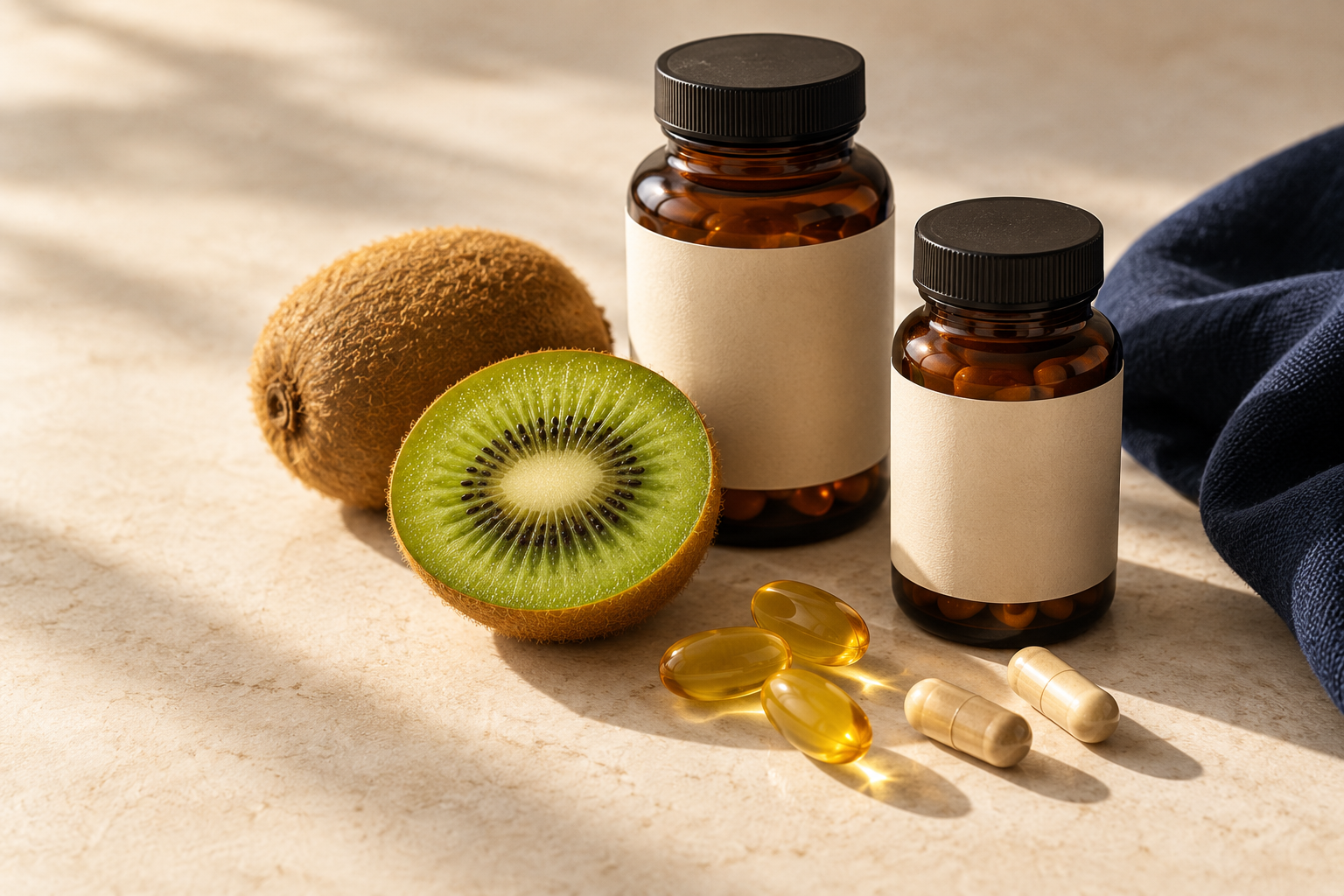
Kiwi: In a small randomized crossover study, eating two or three kiwis daily for 28 days reduced measured platelet aggregation by about 18%. That means platelets clumped less in the test. It does not mean blood became “18% thinner,” or establish that kiwi causes dangerous bleeding with medication. [12]
Interesting biology? Yes. Permission to replace your prescription with fruit? Absolutely not. Kiwi has enough responsibilities being fuzzy.
Pineapple: Bromelain supplements are not equivalent to a serving of pineapple. The enzyme warning does not establish that ordinary fruit portions carry the same risk. [9]
Cranberry and grapefruit juice: These deserve a specific warfarin warning. NHS guidance advises avoiding them with warfarin because they can increase its effect. Those restrictions should not automatically be applied to every other blood thinner. [5]
Leafy greens: These work in the opposite direction with warfarin. Their vitamin K can reduce its effect. Keep intake consistent rather than suddenly abandoning vegetables or starting enormous daily green smoothies. Do not use food to try to “balance out” extra supplements. [5,13]
Check the combination before it becomes a problem
Imagine warfarin plus garlic, ginkgo, high-dose vitamin E and a joint blend. Each purchase had a purpose. Nobody necessarily reviewed the combination.
Photograph every label, including doses. Add aspirin, ibuprofen and occasional products. Have your pharmacist or prescriber check the complete list, especially before surgery or dental work. Do not stop prescribed blood thinners yourself. [1,5]
New unexplained bruising or recurrent nosebleeds deserves prompt advice. Bleeding that will not stop, vomiting blood or black, tarry stools needs urgent medical attention. [14]
At VIGEO, the question is how the whole routine fits together. Bring your list to your consultation, and explore VIGEO's resources. A good reason to take each bottle is not the same as a good reason to take them all together.
Sources
- NCCIH. Garlic: Usefulness and Safety. https://www.nccih.nih.gov/health/garlic
- NCCIH. Ginkgo: Usefulness and Safety. https://www.nccih.nih.gov/health/ginkgo
- NIH Office of Dietary Supplements. Vitamin E: Fact Sheet for Health Professionals. https://ods.od.nih.gov/factsheets/VitaminE-HealthProfessional/
- NIH Office of Dietary Supplements. Omega-3 Fatty Acids: Fact Sheet for Health Professionals. https://ods.od.nih.gov/factsheets/Omega3FattyAcids-HealthProfessional/
- NHS. Anticoagulant medicines: Considerations. https://www.nhs.uk/medicines/anticoagulants/considerations/
- Medsafe. Beware turmeric/curcumin containing products can interact with warfarin. April 2018. https://www.medsafe.govt.nz/safety/ews/2018/Turmeric.asp
- NCCIH. Glucosamine and Chondroitin for Osteoarthritis. https://www.nccih.nih.gov/health/glucosamine-and-chondroitin-for-osteoarthritis-what-you-need-to-know
- Memorial Sloan Kettering Cancer Center. Nattokinase. https://www.mskcc.org/cancer-care/integrative-medicine/herbs/nattokinase
- Memorial Sloan Kettering Cancer Center. Bromelain. https://www.mskcc.org/cancer-care/integrative-medicine/herbs/bromelain
- Memorial Sloan Kettering Cancer Center. Ginger. For mixed human evidence, see Hatfield et al., Dietary supplements and bleeding, 2022 (PMID 36304597). https://www.mskcc.org/cancer-care/integrative-medicine/herbs/ginger
- DailyMed. Vascepa (icosapent ethyl) prescribing information, sections 5.3 and 7.1. Product-specific bleeding results; do not extrapolate to every fish-oil supplement. https://dailymed.nlm.nih.gov/dailymed/drugInfo.cfm?setid=d245ddab-d81b-44bd-90d7-0e4d446d9bf5
- Duttaroy AK, Jorgensen A. Effects of kiwi fruit consumption on platelet aggregation and plasma lipids in healthy human volunteers. Platelets. 2004;15(5):287-292. doi:10.1080/09537100410001710290. Abstract reviewed; platelet outcome, not evidence of medication-related clinical bleeding. https://pubmed.ncbi.nlm.nih.gov/15370099/
- NIH Office of Dietary Supplements. Vitamin K: Fact Sheet for Health Professionals. https://ods.od.nih.gov/factsheets/VitaminK-HealthProfessional/
- NHS. Anticoagulant medicines: Side effects. https://www.nhs.uk/medicines/anticoagulants/side-effects/