
What is actually in your tap water?
Tap and bottled water are convenient. They also frequently contain things nobody put on the label.
Beyond the minerals, water supplies commonly carry:
- Chlorine and chloramine, added deliberately for disinfection. Both are halides, which compete with iodine.
- Fluoride, added in many municipalities. Also a halide.
- Aluminium, used as a coagulant in water treatment.
- Pharmaceutical residues. Antidepressants, hormones, antibiotics and painkillers pass through people, into wastewater, and are not fully removed by conventional treatment.
- Hormones, including from oral contraceptives.
- Microplastics.
- PFAS, the "forever chemicals," now detected in water supplies across much of the country.
- Lead, from ageing pipes and solder, particularly in older housing.
- Agricultural runoff, including nitrates and pesticide residues.
Note how many of those are things I spend my working life looking at on scans. Aluminium. Lead. Fluoride and the other halides competing with iodine. This is not an abstract concern for me.
How distilled water is made
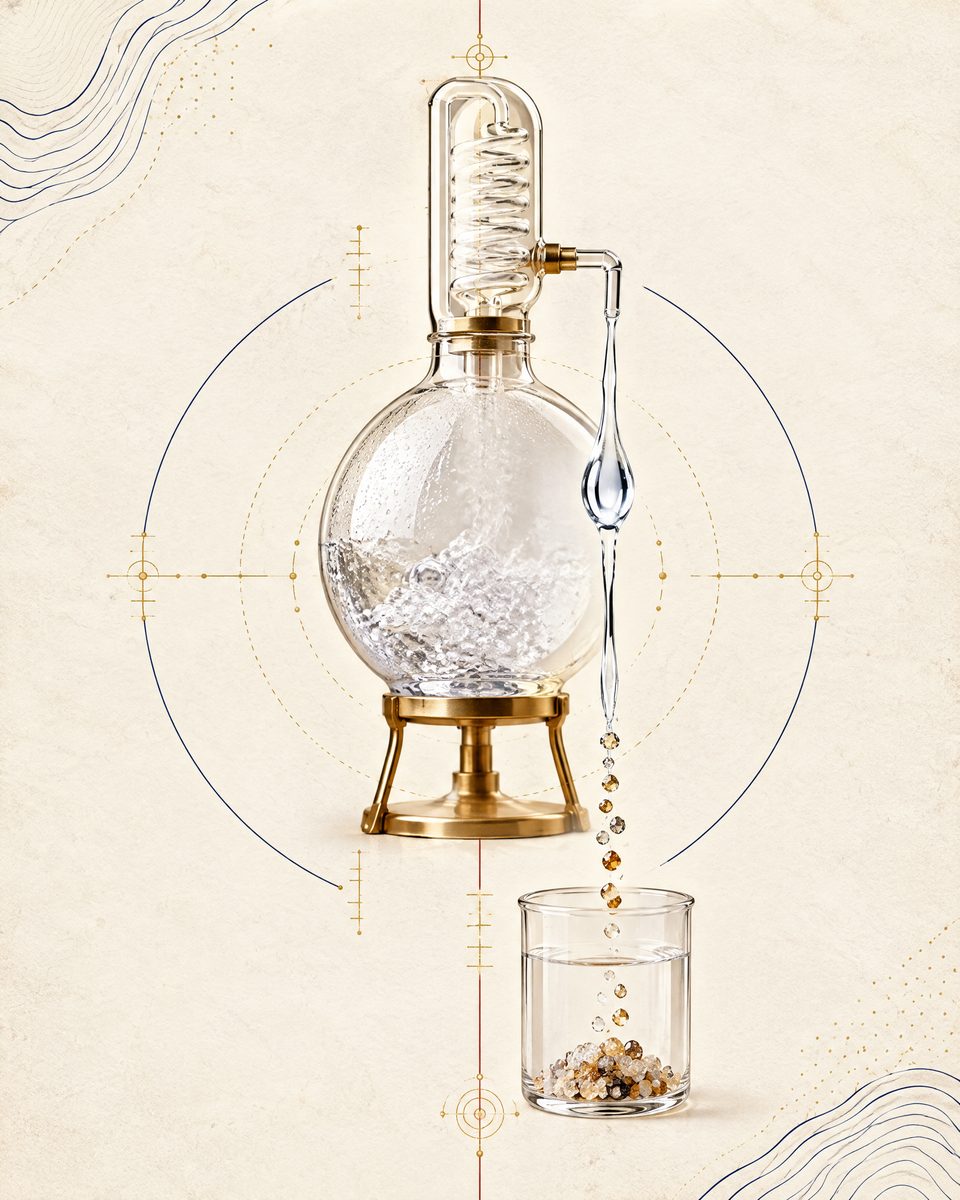
The distillation process involves boiling water, capturing the steam, and condensing the steam back into water.
The impurities are left behind in the boiling chamber. What condenses is essentially pure H₂O.
Why it works so well: most contaminants have a higher boiling point than water, so they simply do not make the journey. That includes heavy metals, most pharmaceutical residues, fluoride, nitrates, and dissolved solids of every kind.
Reverse osmosis achieves something similar. Carbon filtration does not — it is good for chlorine and taste, and poor for dissolved metals and fluoride.
| Method | Removes metals | Removes fluoride | Removes pharmaceuticals |
|---|---|---|---|
| Carbon filter (jug, fridge) | Partially | No | Partially |
| Reverse osmosis | Yes | Yes | Mostly |
| Distillation | Yes | Yes | Yes |
If your concern is contaminant removal, distillation is about as thorough as it gets.
Now the honest part
The debate about distilled water has legitimate competing considerations and is outlined below.
The concern: distilled water contains no minerals at all. Some argue that drinking demineralised water long-term may contribute to lower mineral intake, and that it can affect electrolyte balance if it makes up the great majority of fluid intake. The World Health Organization has published on this.
The counter-argument, which I think is largely right: you are not supposed to get your minerals from water. Food is the primary source, by a wide margin. A single serving of leafy greens, nuts, or mineral-rich broth supplies far more magnesium than a litre of even good hard water.
Where I land: distillation is an excellent way to remove what you do not want. It is a poor way to supply what you do. Those are two different jobs, and the mistake is asking water to do both.
So the practical question is not "is distilled water safe." It is: where are your minerals coming from instead?
If the answer is food, supplementation, and something you have actually measured — distilled water is a good choice.
If the answer is "I had not thought about it," that is the thing to fix, and it was probably true before you changed your water.
The one exception worth knowing about
Here is where I want to be careful, because it contradicts something I have written elsewhere.
Silica-rich water is genuinely useful, and I have made that argument in detail: silicon binds aluminium into hydroxyaluminosilicate, which the body excretes through urine. It is one of the few effective routes for aluminium, and it is part of why Blue Zone regions with naturally silica-rich groundwater are interesting.
Distillation removes silica along with everything else.
So if you are actively working on aluminium, do not rely on distilled water as your silica source, because there is none in it. Use a dedicated orthosilicic acid preparation, or silica-rich mineral water taken separately.
Both things can be true: distilled water for daily purity, and a deliberate silica source for the aluminium work. What does not work is assuming your water is doing a job it cannot do.
What distilled water is good for
- Removing a large source of ongoing contaminant exposure, which is the main reason to use it
- Effective hydration
- Supporting digestive comfort for people sensitive to chlorinated water
- Reducing one variable when you are trying to work out what is affecting you
- Reconstituting anything where purity matters
How to use distilled water well
- Get your minerals from food, deliberately. Leafy greens, nuts and seeds, mineral-rich broth, quality salt.
- Consider adding minerals back to your water if distilled is nearly all you drink. Trace mineral drops or a pinch of unrefined salt cost almost nothing.
- Keep your silica source separate if you are working on aluminium.
- Measure rather than assume. Whether your mineral status is adequate is a question with an actual answer, and it is more useful than the debate.
- Do not overthink it. If you are eating well and your levels are fine, this is a straightforward win. Distilled water is not the highest-stakes decision you will make this year.
Want to distil your own?
Countertop distillers are widely available and make this practical at home: h2olabs.com countertop distillers.
Bottom line
There is a lot of misinformation about distilled water in both directions.
It will not leach the minerals out of your bones. It is also not adding anything to your diet. What it does very well is take things out — and given what modern water supplies contain, that is worth having.
Use it for what it is good at. Get your minerals somewhere you can actually verify.
What this article does not tell you
- This is a preference, not a prescription. Filtered, spring and mineral water are all reasonable choices depending on your situation and your source.
- The demineralised-water debate is real; both sides are outlined above.
- If distilled water is nearly all you drink, mineral intake deserves attention — from food, or by remineralising.
- Distillation removes beneficial minerals as well as contaminants, including silica.
- Water is not a substitute for testing. If you suspect a metal burden, changing your water is a sensible step and not a diagnostic one.
- Anyone with kidney disease or on fluid restriction should follow their physician's guidance on water intake and type.
Go deeper
This article covers what distillation removes and how to use it well. The full picture, including how mineral status is read across all 21 minerals and what water can and cannot contribute, is in Dawn's forthcoming book on interpreting the OligoScan, written with Jeff Lioon Jr.
Join the launch list at oligoscanbook.com
References and further reading
- H2O Labs: distilled water facts
- World Health Organization. Nutrients in Drinking Water, including the chapter on health risks from drinking demineralised water.
- Literature on pharmaceutical residues, PFAS and microplastics in municipal water supplies.
- VIGEO Health Medical Disclaimer
Related
- Does silica in Blue Zone water explain their longevity?
- How do you support your detox pathways safely?
- What the OligoScan measures
Questions and Answers
Q: Is distilled water good for you? A: It is one of the most thorough purification methods available, removing heavy metals, fluoride, pharmaceutical residues and dissolved solids. It also removes all beneficial minerals. Whether it suits you depends on where your minerals come from instead. If that is food, supplementation and something you have measured, distilled water is a good choice.
Q: How is distilled water made? A: By boiling water, capturing the steam, and condensing it back into liquid. Impurities are left behind in the boiling chamber because most contaminants have a higher boiling point than water, so they do not travel with the steam. What condenses is essentially pure H₂O.
Q: Does distilled water remove minerals from your body? A: There is no good evidence that it leaches minerals from bone or tissue, which is the common version of this claim. The legitimate concern is narrower: distilled water contributes no minerals to your intake. Since food supplies far more mineral content than water does, that matters most for people whose diet is already short.
Q: Does distilled water remove fluoride? A: Yes. Distillation removes fluoride, as does reverse osmosis. Standard carbon filters, including most jug and fridge filters, do not remove fluoride, though they do help with chlorine and taste.
Q: Can you use distilled water for aluminium detox? A: Distilled water removes contaminants, but it also removes silica, and silica is one of the few effective routes for aluminium because silicon binds it into an excretable compound. Anyone working on aluminium should use a dedicated orthosilicic acid preparation or silica-rich mineral water as a separate source.