
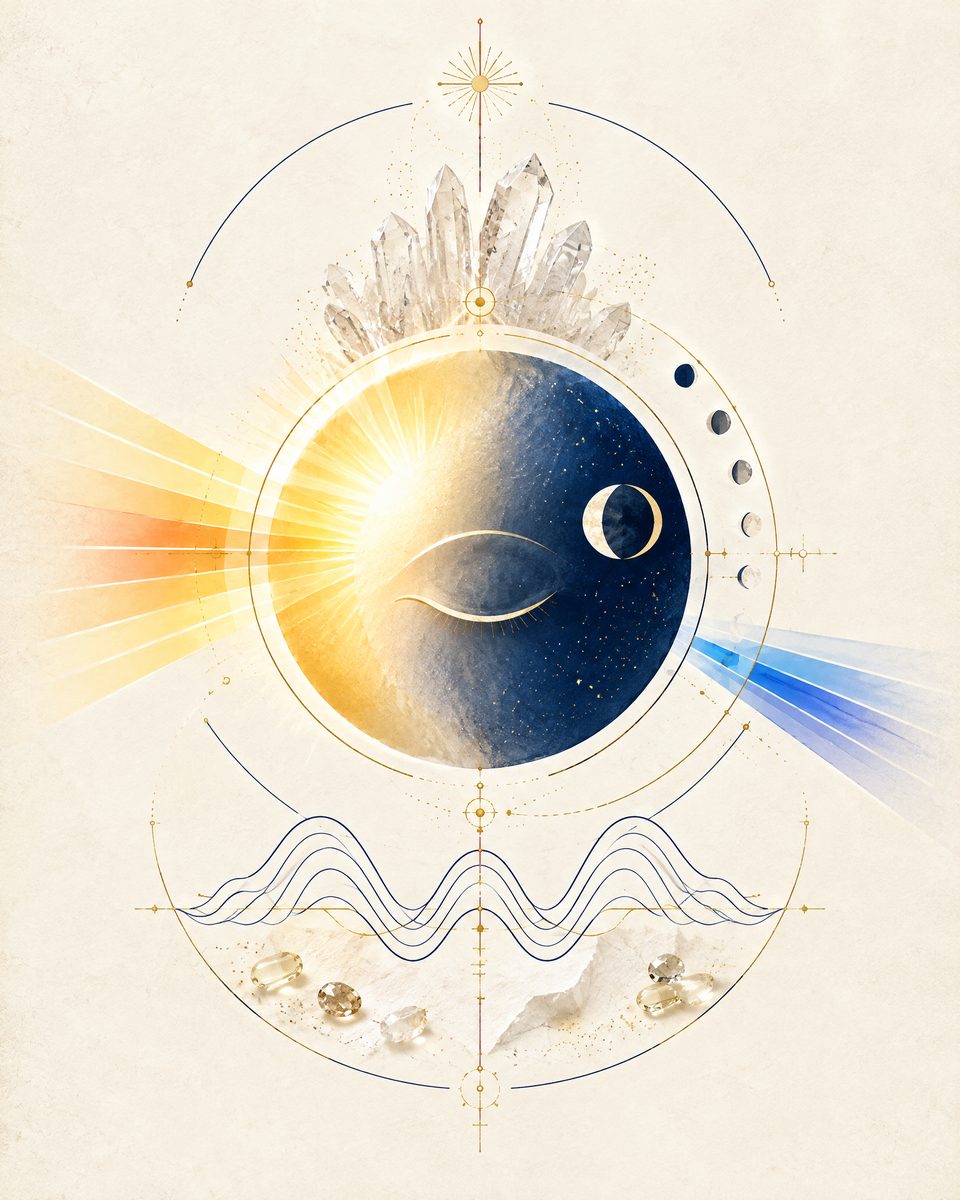
Why light is the thing most people never adjust
People trying to fix their sleep reach for magnesium, melatonin, blackout curtains, a different mattress, an app.
Almost nobody adjusts their light. And light is the primary signal your body uses to decide what time it is.
Some light we see, the visible spectrum and its colours. Some light we feel, infrared and UV. All of it affects us — our physiology, our mood, our overall wellbeing — whether or not we are paying attention.
You are not sleeping badly because you lack a supplement. In a lot of cases you are sleeping badly because your body genuinely cannot tell what time it is.
Blue light: the wake-up signal
Blue light is present in high amounts in natural sunlight during the day, and it plays a critical role in human and plant life.
Here is the mechanism, and it is worth understanding because it explains everything that follows.
Your eyes contain melanopsin-containing retinal ganglion cells — receptors whose job is not vision but timekeeping. They are activated primarily by 480nm blue light. When they fire, they signal your brain to:
- Keep cortisol high, promoting alertness and wakefulness
- Suppress melatonin, the hormone that makes you sleepy
Those wavelengths are abundant in natural sunlight during the morning and daytime. They are also abundant in artificial light above 4000K colour temperature — which describes most overhead lighting, most screens, and most LED bulbs sold as "daylight" or "cool white."
So the problem is not blue light. Blue light during the day is exactly what you want. The problem is blue light at 10pm telling a system built over millions of years that the sun is still up.
Red light: the one that does not interfere
Red light has a longer wavelength and lower energy than blue, sitting at the far end of the visible spectrum just before infrared.
Where blue light is energetic, red light is soothing and nourishing.
And here is the part that makes it practically useful:
Red light has no effect on the production of melatonin.
That single fact is the most actionable thing in this entire guide. It means you can have light after dark, see what you are doing, read, move around your house — without telling your brain to stay awake.
You do not have to choose between darkness and disrupted sleep. That is a false choice, and it is one most people are still living with.
Ultraviolet light: where your melatonin actually comes from
At VIGEO we see a lot of low vitamin D scores, along with other light-related problems.
UV light sits directly below blue and violet visible light — hence ultra-violet — and is too short a wavelength for the human eye to see. It comes in two forms that matter: UVA (315-400nm) and UVB (280-315nm).
UV provides beneficial elements of light you will not find in indoor lighting at all.
Two things depend on it:
Vitamin D. When skin is exposed to UVB, it produces vitamin D, which is crucial for immune function, bone health, and a long list of other processes.
Serotonin. UV exposure increases serotonin production, the neurotransmitter regulating mood, which helps alleviate symptoms of depression and other mood disorders.
And here is the connection that explains winter
Serotonin is the precursor to melatonin.
Serotonin is produced during the day, in response to light. It is only converted to melatonin in darkness.
So:
| Season | What happens |
|---|---|
| Summer — long days, short nights | Serotonin levels higher. Better mood, calm but focused. |
| Winter — long nights, short days | Melatonin levels higher relative to serotonin. |
Seasonal Affective Disorder has been linked to low daytime serotonin and a delay in melatonin production. That is why SAD lamps are popular in northern months when daylight is scarce.
Read that sequence again, because it upends how most people think about sleep: the melatonin you need tonight is built from the light you got this morning. You cannot fix a sleep problem entirely at bedtime. A good part of it was decided at breakfast.
Infrared: the half of sunlight nobody talks about
Here is a fact that surprises almost everyone.
Infrared light makes up 52 to 55% of sunlight. More than half of what the sun delivers is light you cannot see, only feel as warmth.
Infrared sits at 780nm and longer, divided into near (IR-A), mid (IR-B) and far (IR-C). You feel it as thermal energy — the heat from a fire, or from an old incandescent bulb.
Red and near-infrared are the only wavelengths able to penetrate the skin, promoting cell regeneration, tissue oxygenation, and energy production in the cells themselves.
Its documented uses:
| Application | Effect |
|---|---|
| Pain relief | Reduces pain and inflammation by promoting endorphin release and increasing blood flow |
| Reduced inflammation | Relevant to arthritis, tendonitis and other inflammatory conditions |
| Improved circulation | Increases formation of new blood vessels, promotes blood flow to damaged areas |
| Skin health | Stimulates collagen production, reduces fine lines, promotes wound healing |
| Athletic performance | Improves muscle recovery and reduces muscle fatigue |
Why this matters for the guide: modern LED lighting produces almost no infrared. Incandescent bulbs and firelight produce a great deal. We swapped out our lighting for efficiency and quietly removed more than half of what natural light used to give us.
The protocol: what to actually do
Everything above is the reasoning. This is the part to act on.
The principle in one line: bright and blue by day, dim and red by night.
Morning, within 30 to 60 minutes of waking
- Get outside. Ten to twenty minutes, even overcast. Outdoor light on a cloudy day is many times brighter than indoor lighting.
- No sunglasses for this part. The signal has to reach your eyes to work.
- Do not look at the sun. You do not need to. Ambient outdoor light is enough.
- If you cannot get outside, sit by the brightest window you have, or use a light box.
This is the single highest-value habit in the guide, because it sets the timer for tonight's melatonin.
Midday
- Get outside again if you can, ideally around lunch. Skin exposure supports vitamin D; eye exposure reinforces the clock.
- Balanced UV exposure matters. Enough for vitamin D and serotonin, not enough to burn. Duration depends on skin tone, season and latitude.
Afternoon
- Keep your workspace bright. Dim afternoon light is a weaker signal than most people realise.
- Consider red or near-infrared if you use it for recovery or pain. This is the natural window for it.
Evening, from roughly two to three hours before bed
- Drop the colour temperature. Switch to lamps under 3000K. Overhead lights above 4000K are working against you.
- Get low. Lamps at eye level or below signal evening. Overhead light signals midday.
- Use red light. Red bulbs, salt lamps, candles, firelight. Remember: red does not touch melatonin. You can see perfectly well without paying for it in sleep.
- Screens on warm mode, or wear blue-blocking glasses. Amber and red-tinted block more than the pale yellow ones.
The last hour
- Lowest light you can manage. Red only if possible.
- Screens off, or accept that you have chosen alertness.
Overnight
- Dark. Cover LED indicators, use blackout curtains, or wear a mask.
- If you need a night light or get up in the night, make it red. This is the easiest swap in the whole list and it changes whether a 3am bathroom trip costs you the rest of the night.
Winter
- Front-load your light. Shorter days mean the morning signal matters more, not less.
- A SAD lamp helps when daylight is scarce, used in the morning rather than the evening.
- Check your vitamin D, since low UV exposure means low production, and this is measurable rather than a guess.
Give it two weeks
Light-driven changes are not instant. You are re-setting a clock, not taking a sedative.
Most people notice something within a week and a clear difference within two. Start with the morning light and the red evening light — those two alone do most of the work.
What light will not fix
Being straight with you, because this guide could otherwise sound like an answer to everything.
- Sleep apnoea. If you snore, wake gasping, or feel unrefreshed after eight hours, get assessed. No amount of light management touches this and it is genuinely serious.
- Thyroid dysfunction, iron deficiency, and low B12 all disrupt sleep and are correctable.
- Mineral status. Magnesium in particular is required for the enzymes that build melatonin from serotonin. Perfect light with depleted magnesium is a partial answer.
- Genuine insomnia disorder, anxiety and depression need proper care. Light is supportive, not a substitute.
- Caffeine timing, alcohol and late meals will outweigh a red bulb.
And a note on vitamin D. Low levels are common, but supplementing blind is not the answer. Vitamin D works alongside magnesium, vitamin K2 and boron, and taking it in isolation can create new imbalances. Measure rather than assume.
Go deeper
This article covers how light shapes sleep, and a protocol to act on. The full picture, including how vitamin D and the minerals that sleep depends on are read together on a scan, is in Dawn's forthcoming book on interpreting the OligoScan, written with Jeff Lioon Jr.
Join the launch list at oligoscanbook.com
References and further reading
- Health Lighting. Guide to the spectrum of light
- Health Lighting. A complete guide to health and light
- EMR-TEK. UVA vs UVB
- Literature on melanopsin-containing retinal ganglion cells and circadian entrainment.
- Research on the serotonin to melatonin conversion pathway and seasonal affective disorder.
- VIGEO Health Medical Disclaimer
Related
Questions and Answers
Q: How does light affect your sleep? A: Light is the primary signal your body uses to set its internal clock. Melanopsin-containing retinal ganglion cells in the eye, activated mainly by 480nm blue light, signal the brain to keep cortisol high and suppress melatonin. Blue light during the day supports alertness; the same light at night prevents the melatonin release that makes you sleepy.
Q: Does red light affect melatonin? A: No. Red light has no effect on melatonin production, which is why it is the best option for evening and night-time use. It allows normal visibility after dark without signalling the brain to stay awake, so darkness and disrupted sleep are not the only two options.
Q: Why do you sleep worse in winter? A: Serotonin is produced during the day in response to light and is only converted to melatonin in darkness. Shorter winter days mean less daytime serotonin production and a delay in melatonin production. Seasonal Affective Disorder has been linked to exactly that combination, which is why morning light exposure matters more in winter, not less.
Q: How much of sunlight is infrared? A: Between 52 and 55%. More than half of the energy in sunlight is infrared, which is invisible and felt as warmth. Red and near-infrared are the only wavelengths able to penetrate the skin, supporting cell regeneration and tissue oxygenation. Modern LED lighting produces almost none of it.
Q: What is the most important thing to change for better sleep? A: Morning light exposure. Getting outside for ten to twenty minutes within an hour of waking, without sunglasses, sets the timing for that night's melatonin release. The melatonin you need tonight is built from the light you received this morning, so a sleep problem cannot be fully solved at bedtime.